The bleak headlines about the impact of Covid-19 continue and of course our hearts are saddened by the relentless loss of life for frontline NHS staff and Covid-19 affected patients alike.
Any thoughts about how and when an early release from lockdown might occur, must of course be balanced with the high probability of new after waves of coronavirus cases occurring post lockdown, with perhaps the inevitable mini lockdowns being put in place from time to time. There are valuable lessons to be considered from past pandemics especially about the exit stages.
We can be certain that our exit from the current lockdown, will not mean a return to normal in many aspects of day to day life. It is likely we will continue with social distancing and simple matters like viewing property, will be conducted in a similar manner to that which occurred just before the lockdown started.
The House Market
As I mentioned in our last update, writing a few lines about the property market right now doesn’t seem that important in the current circumstances, but house sellers, landlords, buyers and tenants continue to seek insight, because the prospect of needing to move house is still a journey they will embark on post lockdown.
Buyer Attitudes
I remain impressed with the resilience of house buyers, who continue to remain upbeat about their moving plans. This positive attitude is supported by the fact the 95% of the sales arranged we had in place at the start of lockdown, continue to remain in place with vendors and purchasers keeping focused on the opportunity to exchange and complete some time soon.
Other mini indicators of buyer intent are told to me by staff, such as Matthew Fenn from our Fleet branch who has 27 buyers who want to view specific properties as soon as lockdown is over.
Contracts Are Exchanging
Some house sales are progressing to the exchange and completion stages during lockdown, mostly by exchanging and completing on the same day.
Two examples of this in the last week include a £400,000 guided house in Fleet (top image below) and stunning country house conversion in Winchfield at a guided sum of £1.250m. (video below). These special cases where exchange and completion can happen are frequently new house purchases where there are no chains.
Exchanged and completed last week
Exchanged and completed last week
Working From Home
Creating new sales is virtually impossible due to viewing restrictions, but our negotiation staff are keeping closely in touch with buyers on our books, by phone, email, newsletter and even video presentations. This means that post lockdown we are already creating a list of buyers who want to view specific properties as soon a we are release from lockdown.
More Vendor Inspired Video House Marketing This Week
Many clients continue to ask if we could produce video content of their property if they sent us video clips and still photographs, this enabling them to go on the open market now.
Some of the latest collaborative results are below.
Preview – due to the market soon at Est. Guide £1,675,000
New to the market – Guide £850,000
This works by vendors sending us the video clips and then with some editing help from johnjoe.co.uk a promotional video tour is created.
We look forward to many of these collaborative home grown marketing initiatives in the weeks ahead.
The Week Ahead
In the week ahead we will be giving special focus to our new homes selection of properties for sale, because as we emerge from lockdown we believe the attraction of owning a new home will be higher than usual.
Right now we have 13 new homes development sites available for sale, showcasing a most diverse range of interesting properties for 2020, in amazing locations from rural Eversley in Hampshire, to Virginia Water in Surrey.
The developers we are representing in 2020 are as diverse in size and their personal history as you can imagine, but they all share the same passion for creating beautiful homes and leaving a legacy to their brand and reputation.
Click some of the links below to preview some of the new homes available.
In the week ahead we will no doubt continue to think, reflect and pray about key workers and NHS people and the risks they face each day at these times.
T A Fisher will be releasing for sale two new properties at Castlebrook, their small quality development in North Warnborough, near Odiham in Hampshire.
Number 5 Castlebrook will be selling at a guide of £540,000 and we are delighted to provide this news item early.
5 Casltebrook - For sale at £540,000
There are only 11 homes being created at Castlebrook, and at our 23rd November preview event plots 6 and 11 were reserved, so a flying start and the sale of these fine properties which haven’t yet been seen on property portals such as Rightmove.
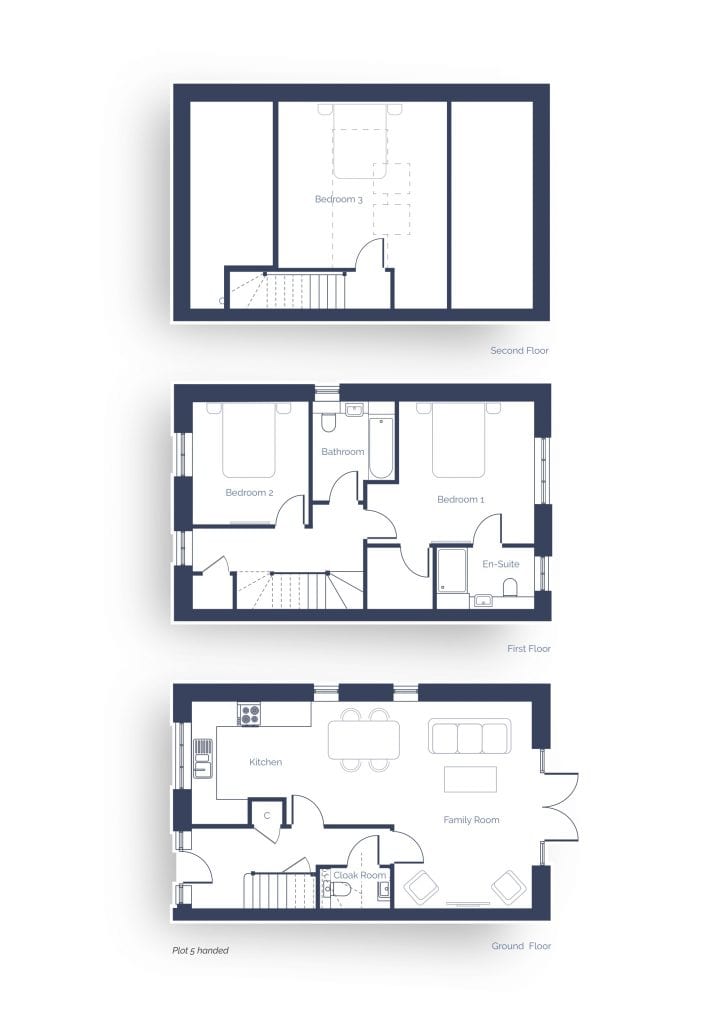
5 Castlebrook is an end-terraced house, providing around 1,200 sq. ft. of space. The floor plans are shown below and the master bedroom with en-suite shower room and dressing room is an outstanding feature.
The above video tour will tell you about the area and showcase plot 6, a mid-terrace house providing around 1,200 sq ft of superb space. We think you’ll be impressed.
Architectural Detail
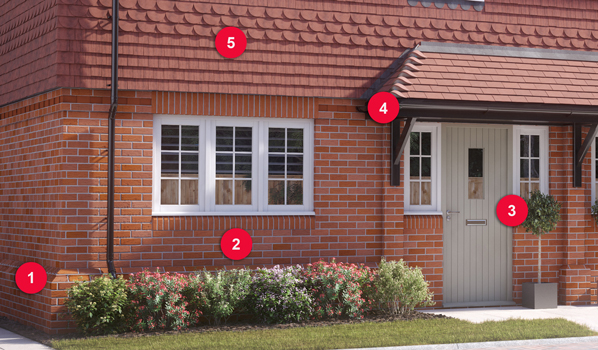
We have been impressed with many aspects of the T A Fisher new homes, and we were most impressed with the architectural detail of the terraced properties plots 5, 6 and 7. Some of the eye catching features are shown below – 1. Distinctive plinth brick course. 2. The soldier course brick detail to window surround 3. The elegant front doors 4. The substantial porch 4. The wealth of attractive tile hanging to the front and side elevations.
Such attention to detail and styling is to be applauded.
5 Castlebrook will be available from Boxing Day.
To arrange to view 5 Castlebrook, and the show house at 6 Castlebrook early in the New Year telephone ourOdiham branch on 01256 704851.
Next re-open days for McCarthy Holden after Christmas are Friday 27th and Saturday 28th (both 10-2)
Find out about the next big property event on Boxing Day, an take a look at our Pre-Christmas edition of the magazine In The Country & Town, which sets out to showcase some of the most exquisite homes, as well as deliver engaging editorial content and of course comment on the house market.
In addition to some amazing properties, our editorial features includes Cocktails at Downton, Go Anywhere with Land Rover and the new film release The Aeronauts.
Just click on the image below to open a new tab and view the magazine page by page and indulge in some wonderful online reading.
Our new homes feature runs from page 32 to page 48, and is full of amazing new homes from diverse and individual developers, with prices from around £450,000 to £1.850m.
It’s been nearly five years since The Theory Of Everything co-stars Eddie Redmayne and Felicity Jones appeared on screen together – and now they’re teaming up once again for biographical adventure, The Aeronauts.
The epic – directed by Tom Harper and co-written by Harper and Jack Thorne – tells the tale of two high-flying balloonists, pioneering meteorologist James Glaisher and daredevil pilot Amelia Wren, united in a record-breaking voyage in Victorian England. And nothing says ‘reunion’ quite like filming 70% of your scenes in a confined basket, reveals the British duo.
As fans of Downton will know, the Crawleys’ love of cocktails is well storied. But it wasn’t until season two and three – when Robert asks his mother, Violet: “Can I tempt you to one of these new cocktails?” – that the family adopts the 1920s American customs of an aperitif before dinner, and hosting cocktail parties at home. Now, the Downton Abbey Cocktail Book means viewers can recreate these tipples at their own soirees.
Embracing the adventurous spirit that has defined the Discovery family for the past 30 years, the new Discovery Sport is a striking evolution of the original that does not compromise capability……. new electrified engines include a 48-volt mild hybrid from launch to help reduce emissions and fuel consumption.
If you are planning a house sale or let and would like your property showcased in the New Year edition of In The Country & Town, contact your nearest McCarthy Holden branch and ask for details.
The Next Big Property Event - Boxing Day
Boxing Day – The Perfect Time To Put a House Up For Sale!
According to Rightmove there is a massive spike in online buyer search traffic, between Boxing Day and early January, suggesting an uplift in house buyer searches online on Boxing Day. This is why McCarthy Holden are offering a special incentive to join the next big event in property, the Boxing Day Go Event.
During November and December all a would-be house seller has to do is instruct McCarthy Holden to offer their property for sale from Boxing Day.
You can indulge in all of the traditional Boxing Day activities, happy in the knowledge that house buyers are tapping on mobile devices searching for the right property and, who knows, your house could be top of their list for viewing in the New Year.
Many of our clients have already asked to go live on the Boxing Day Go property launch, so if you are contemplating a house move in 2020 then go to our home page and click on valuation, for a free property appraisal and discover the benefits of being part of the no sale no fee and no obligation Boxing Day Go property event.
Start a new career as a property negotiator / property consultant in 2020, by joining McCarthy Holden at either their Fleet or Hartley Wintney branches in Hampshire.
Positions are available at both of these branches, for either individuals already working in estate agency as an experienced negotiator, or for individuals who are currently in a career sector such as the service industry.
If you are an estate agency negotiation with around two years experience we would welcome the opportunity to meet you and explore the career opportunities at McCarthy Holden. We find negotiators who join us with this kind of experience stay with us, many now for 10 to 20 years so we hope this indicates that the real skill of negotiating is something that is highly valued, as opposed to relying on algorithms and online property portals.
For those of you not currently working in estate agency, the refreshing news is that some of our most successful property consultants moved from careers such in the hospitality, retail and wider services business sectors. A couple of examples are shown below.
Victoria - Fleet branch
Victoria joined McCarthy Holden in 2010, when she left a career in the hospitality industry. She has forged a very successful career at McCarthy Holden and is highly respected by customers and colleagues alike.
Matthew - Fleet branch
Matthew left British Rail in 2015, to pursue a negotiating and client management career at McCarthy Holden. His career in estate agency is now firmly established and just like Victoria he is much respected by customers and colleagues.
We are looking for people with a healthy work ethic, who in return for high property sales performance will bring high salary rewards, and yes there are long working days, with frequent out of hours needs of customers to be dealth with.
At McCarthy Holden we won’t crush your spirit with targets for selling financial services, but instead allow you to care for obtaining the best possible price for our vendors by applying negotiating skills and following though with managing the sale process from start to finish.
Every day will be varied and different, but one thing that will not change is our desire to deliver our services with traditional values of trust, honesty and respect for our customers and colleagues. These values are very important, so only candidates that who can truly deliver on these essential traits should apply.
Excellent communications skills are essential.
Because we are looking for both experiences and career change candidates, the salary / rewards scales are varied so please apply in the knowledge that we aim to match or exceed the market levels in the area of salary rewards.
Working in your local community is such a rewarding job, and Saturday work at McCarthy Holden results in a part time job that provides a great mix of meeting customers in the branch and viewings at properties, so the day is varied.
We have several part time positions at both our Hartley Wintney and Odiham branches, so if you are looking for a part time Saturday cover career as a property negotiator in 2020 then please get in touch.
At McCarthy Holden we care for obtaining the best possible price for our vendors by applying negotiating skills as opposed to relying on algorithms and online property portals, so excellent communication skills are essential.
Every day will be varied and different, but one thing that will not change is our desire to deliver our services with traditional values of trust, honesty and respect for our customers and colleagues. These values are very important, so only candidates that who can truly deliver on these essential traits should apply.
Lisa Salmon speaks to a property expert to find out the best ways to avoid the moisture menace which can lead to damp.
Condensation is something none of us want in our homes, as it’s the most common cause of damp problems.
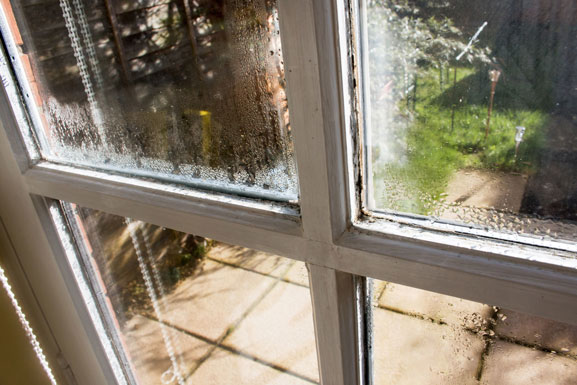
It’s actually a very common issue, affecting one in five homes – and it can be found in properties of any age, size or design. It occurs when humid warm air comes into contact with a cold surface. Warm air can hold a lot more water vapour than cold air, so when it’s rapidly cooled by a cold surface, it can quickly form into the water droplets typical of condensation. Everyday activities, such as cooking, boiling the kettle, using hot water in the shower or bath, or drying clothes inside, can contribute to condensation forming inside a property.
Richard Walker, national technical and development manager at property preservation experts Peter Cox (petercox.com), explains: “Condensation is the visible consequence of the production of moisture within a building, and most commonly occurs between October and April. On average, a family of four produces 14 litres (24 pints) of water vapour each day, so keeping a house correctly heated and well ventilated is an important part of preventing condensation. If left unaddressed, mould and damp can also begin to form, which is not only unsightly, but may create health risks for the occupants.”
Here, Walker suggests six ways to help address a condensation issue, but points out that if it persists or deteriorates despite trying everything, homeowners should consider contacting an accredited surveyor to investigate the cause and suggest a solution.
1. Ventilate your house
Where possible, ventilate the house to let the build-up of water vapour escape, particularly if you’re drying clothing indoors. If you have double glazing, then keep the trickle vents open. When cooking or boiling a kettle in the kitchen, or using hot water in the bathroom, close the doors and put the extractor fan on to prevent the moisture from escaping to colder rooms and collecting on the walls.
2. Consistent central heating
When you turn the central heating on, heat the whole property on a low heat, rather than leaving some rooms cooler and susceptible to condensation. ‘Yo-yo’ heating doesn’t warm the fabric of the building and unnecessarily increases the risk of condensation forming.
3. Avoid dehumidifiers
Despite their popularity, dehumidifiers merely mask the condensation problem and don’t address the real cause. They can require frequent emptying and will stop once the collector unit is full. Moreover, they’re noisy and can be costly to buy and run.
4. Don’t let condensation settle
If you spot condensation forming in the home, it’s always advisable to wipe damp surfaces down, rather than letting it settle. Remember to wring the cloth out in a sink, rather than letting it dry in the room. When condensation is allowed to settle on a surface for more than six hours, it creates the conditions for mould to form, which in some cases, can damage surfaces by staining.
5. Regular maintenance and expert advice
Regular maintenance is key to preventing ongoing issues. Identify any problem areas as they occur and seek professional advice to address them immediately. Every case is different, and property care specialists are trained to evaluate the specific causes of condensation issues and advise homeowners on how to prevent any reoccurrence.
6. Consider installing a Positive Input Ventilation system
Positive Input Ventilation (PIV) units are sophisticated ventilation and condensation control units to aerate entire homes. Property surveyors may recommend the installation of a PIV system to help to ventilate a building, by diluting and displacing any damp air. From installation, the unit gently ventilates the home with fresh air, which is pushed back down into the house and redistributed. Such systems tend to cost around £250-£400.
Visit the T A Fisher Show House Saturday 5th October
We are now only a few weeks away from being able to view the superb new homes in North Warnborough, by renowned developer T A Fisher.
Plots five to seven are to be released for sale on 5th October and the anticipated price ranges is around £475,000 to £500,000.
So make a diary note to come and view the show house, and explore the scale and quality of these new homes. Telephone 01256 704851 to make arrangement and find out the opening times.
Plots 5, 6 and 7
Plots 5, 6 and 7 are a terrace of three stylish homes, each arranged over three storeys, and each offering you some surprising lifestyle enhancements.
On the ground floor, you’ll find a spacious, bright and airy open plan living room, dining room and fully integrated kitchen with double French doors to the rear garden to make the most of the natural light. There’s also a convenient downstairs cloakroom and storage cupboard off the entrance hall.
Upstairs the surprises really begin. There are two double bedrooms on the first floor where the master has an en-suite and a walk-in dressing area. On the top floor, you’ll discover an attic room. This could easily be a lovely third bedroom, nursery, a den or games room for youngsters.
These beautiful homes give you space, flexibility and practicality.
A Small Select Development
Castlebrook is a small select development of 11 homes, 7 of which are new build and 4 highly individual and intriguing conversions.
Wonderful Location
You can’t help fall in love with this area, steeped in history with beautiful old historic buildings and places of interest such as King John’s Castle and a lovely pub and restaurant which was a watermill just across the road from this site.
There are great opportunities nearby for activities such as walking, cycling and perhaps even water based on the Basingstoke Canal.
Choosing the right veg for your experience level can make a world of difference. Hannah Stephenson shares her top picks.
National Allotments Week is approaching (August 12-18), with gardeners being encouraged to share their harvests and exchange tips.
And if you’re relatively new to the grow-your-own scene, it’s always handy to hear about what’s easy and what’s not – and which crops to tackle once you’ve got a bit more experience under your belt.
Here are three easy veg for beginners, and three more challenging crops for the seasoned allotment holder…
EASY:
1. Onions
The great thing about onions is you can be harvesting them from February to September, if you plant different types.
For the quickest results, grow onions from sets (small bulbs), planting summer (maincrop) types in March and April, in well-cultivated, weed-free ground, pushing the sets gently into the soil so the tips are level with the surface. Spacing depends on the size of the set, so for small bulbs, plant them 2.5cm apart in rows 15cm apart.
Just keep plants watered in dry spells and you could have a succession of onions for much of the year. Spring onions can be harvested as soon as they are big enough to use, while maincrops will be ready in August and early September, when the leaves turn yellow.
Top tip: Keep on top of weeding because onions can’t compete. You’ll need to hoe or hand-weed regularly.
2. Swiss chard
This veg not only tastes good but also makes a great ornamental addition, as there are several types with coloured stalks which add vibrancy to any veg patch or potager.
Related to leaf beet, you can sow it from April to mid-July in rows outside, then thin the seedlings out to 15cm apart, allowing 30cm between rows. The only thing you need to do is keep it well watered in dry spells and free from weeds. It should be ready for picking from July to October.
Top tip: Swiss chard doesn’t travel well as the leaves look sorry a day after picking, so use it fresh.
3. Courgettes
These wonderful summer veg, great grilled on the barbecue or sliced thinly in salads, are easy to grow, provided you give them enough space (one plant will fill a large container). Their yellow flowers are also edible and can add colour and mild flavour to salads.
They need to be started off indoors in spring, sowing singly in pots on a windowsill in April, and then hardening off outside before you plant them after the last frost has passed, at the beginning of June.
Prepare the soil by filling a hole with compost and topping it off with soil to create a low mound, so excess rainwater runs away from the base of the plant, helping prevent stem rot. Space them 60cm in each direction and lay mulch over the soil to retain moisture and smother weeds.
Keep them well watered during the warmer months and feed them with tomato feed every week once fruits have formed. You should be picking them from July to October and have plenty to share with your allotment pals with just a few plants.
Top tip: Choose a variety bred specifically for courgette growing, rather than a marrow type where you can pick the fruits when they are small, because your yield will be better. Good varieties include ‘Soleil’, ‘Clarion’ and ‘Parthenon’.
A BIT TRICKIER…
1. Florence fennel
This aniseed-flavoured veg with a swollen white bulb-like base is delicious used raw in salads or roasted in the oven.
It’s challenging because it prefers a Mediterranean climate, so you need to mimic that as much as possible growing it in a warm spot in light, well-drained soil, working in plenty of organic matter and watering it during dry spells.
Its main problem is bolting – when it produces flowers and runs to seed – which will make the bulbous base inedible. This can be caused by lack of organic matter in the planting area, dry soil and sudden swings in temperature.
Start the seeds off indoors in May, sowing three seeds each in small pots. Germination can be erratic, but remove the weakest two, leaving one seedling per pot.
Harden the plants off carefully before planting outside at the end of June, or when there’s a prolonged period of warm weather. Water them carefully – you don’t need much to start with, but don’t let them dry out.
If you want to sow outside, leave sowing as late as you can, probably late June or early July, as Florence fennel will bolt if sown too early or in a cold summer. The seeds should be sown directly into a well-prepared seedbed. It grows quickly and should be ready in late August and September.
Top tip: Cover young plants with fleece at night if it’s chilly, even in the summer.
2. Cauliflower
Now a designer veg, with purple and lime-green varieties as well as the traditional types, have a go with them on the allotment if you fancy something a little more challenging. The main problems are bolting and poor soil.
You can get summer, autumn and winter varieties which you’ll need to sow at different times of the year – the only one which can be started off outdoors is the winter variety, which can be sown in April and May.
The biggest job is really good soil preparation. They like clay soil which isn’t waterlogged. If you have light soil, dig in plenty of organic matter. If you have acid soil, add lime over the winter to give it a pH of 7 and a good boost of balanced fertiliser, working it into the soil before planting.
Water young plants in well but once they’re established, only water if the soil becomes very dry. Too much water will encourage bigger leaves, rather than curds.
To stop them bolting, feed and water seedlings well and transplant them no later than six weeks old. When the curd looks full-size, cut it off just below the base of the head.
Top tip: When small curds appear in the centres of the plants, bend a few outer leaves over for protection from bad weather, snapping them so that they stay in place.
3. Celery
Delicious in salads, as crudites or cooked in stews, celery does, however, need attention to detail when growing. Sowing needs to be done indoors in relatively high temperatures (60-70°F/16-21°C). For the best chance of success, choose a self-blanching type.
Celery needs rich, fertile soil, which has had plenty of well-rotted organic matter worked into it beforehand. Plant the seedlings out in early June, after the last chance of frost has passed, spacing the plants 23cm apart in all directions. They need close spacing as the plants need to shade each other’s stems.
Water in well and keep them watered regularly. If you let the plants get remotely dry or water irregularly, you’ll lose the crop. Give them a liquid feed regularly too using a high-nitrogen feed, and keep them well weeded.
Top tip: Be vigilant against slugs, which can settle in and feed on the central stems, making the celery unusable.
National Allotments Week runs from August 12-18. Visit nsalg.org.uk.
Little beats a lingering outdoor meal in summer. Gabrielle Fagan reveals three ways for setting the scene in style.
There's something about eating outdoors. A generous helping of fresh air and (hopefully) sunshine can magically make even the simplest meal taste delicious.
That’s all to the good, because summer’s no time to be slaving over a hot stove indoors – but that doesn’t mean you shouldn’t take a little time and trouble over the table.
By giving a setting a real sense of occasion, maybe opting for a theme, you’ll not only make it memorable but you could ramp up the fun – a few drinks could turn into a party and a supper into a celebration.
“Having lunch and supper parties outside is one of the real joys of summer,” enthuses interior designer, Joanna Wood. “I really like using unusual nature-inspired dishes in the shapes of leaves, and I like to work to a theme and pick a different one each year.”
This year she’s creating her own ‘Midsummer Night’s Dream’ al fresco setting, to give a patio area a theatrical touch. “A theme allows you to be creative and you can incorporate flowers, candles and maybe floating flower heads with tea lights for evening parties,” she says. “It’s all about a bit of imagination and planning that will result in something you can enjoy for the whole season.”
So turn the tables on dull dining and instead experiment with one of these three themes: Love Island style, a fun festival vibe, or a little slice of calm with country cool…
Dine like a Love Islander
If you envy those fit reality TV show residents in their sun-drenched Mallorcan villa, create your own sizzling Mediterranean hotspot. It could be perfect for leisurely meals and chilling (romancing optional!).
Group potted palms, ferns and other tall foliage around simple seating. Low benches or boxes made comfy with foam rectangles wrapped in bright fabric will do nicely. Finally, inject another zip of sunshine colour with outdoor rugs and cushions. Then sit back and enjoy the banter!
Mix a decor cocktail and pick up on Love Island style with slogans and beach style accessories – pool blue and flamingo pink rules!
Go full-on festival
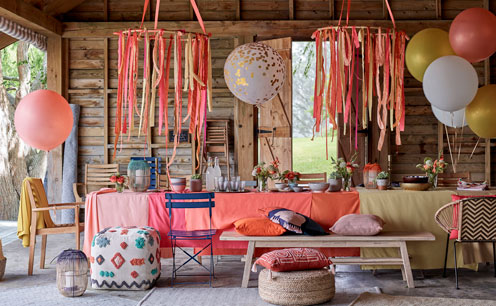
Festival season’s arrived. No tickets – no problem! Simply give a table setting a boho, laid-back vibe, turn on the sound system, and have your own personal ‘feastival’ – without the mud, wellies or sagging tents.
This look i all about personality – pops of colour, mismatched china, and lots of freshly cut flowers and foliage. Don’t take it too seriously – there’s no room for formality here – just give it a bit of hippy-dippy character that makes it kick-off-your-shoes relaxing.
Feel free to pile on the paper lanterns and garlands – use solar lights for when the sun’s gone down – and add jewel-coloured glassware for a dash of glamour.
John Lewis is a brilliant destination for homeware that will ramp up al fresco style, including a brilliant range of tableware and furniture. Their Croft Collection Garden Dining Table Bench, £220, is ideal, while a Camden Garden Bistro Table and Chairs Set is currently reduced to £63 from £79. A Sol Pouffe – Multi, £120, makes a great finishing touch.
Conjure country cool
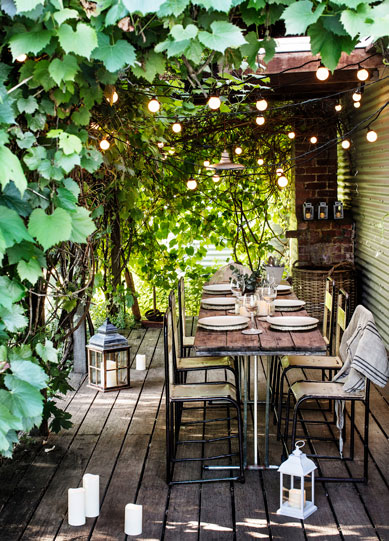
The beauty of a rustic scene is its simplicity. All that’s needed are a wooden table and chairs, a linen runner and napkins, and plenty of lanterns and candles. Don’t forget to cater for chilly nights by putting a throw or a blanket on each chair.
“I live on a farm in the glorious West Country, so I really enjoy the chance to make the most of time outdoors with friends and family. And come the summer months, there is nothing I love more than a picnic or eating al fresco,” says Liz Earle, founder of Liz Earle Wellbeing magazine (lizearlewellbeing.com).
“Picnics and meals outdoors are a great way of enjoying the great outdoors and making the most of nature’s beauty, but they don’t just have to be daytime affairs. There’s nothing nicer than lingering over a meal on a sultry evening and pretty lighting will transform a setting.”
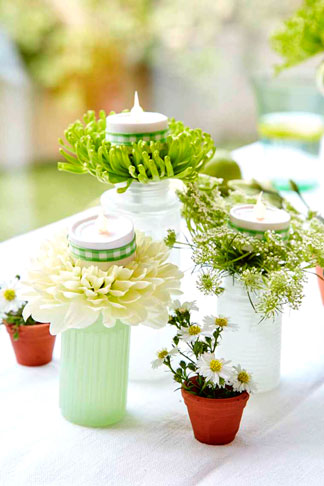
Battery operated tea lights, which will twinkle into the night, are a pretty and safe way to add enchantment, Earle says.
“Perch them atop jam jars or logs to give them a bit more height, or use them in hanging glass lanterns above a table to turn it into a focal point,” she suggests.
The closer you get to echoing your indoor taste outside in your garden ‘room’, the more successful the result will be. Opt for accessories that would look just as good in a living room as on a terrace.