
How to attract beautiful dragonflies to your garden

Experts offer tips on how to get your gardening buzzing with these colourful insects.

So often during the summer, we see iridescent dragonflies and damselflies flitting between plants and water on river paths or lakeside walks, but how do we tempt them into our gardens?

Modern-day development, drainage and pollution have meant numbers have fallen dramatically, along with the reduction in ponds over the 20th century. Ponds are particularly important as dragonflies spend most of their lives as aquatic larvae, so need water to survive.

Ruary Mackenzie Dodds and Kari de Koenigswarter, authors of The Dragonfly-Friendly Gardener, who advised Exbury Gardens in the New Forest on its new dragonfly area, have the following tips on how to attract these colourful creatures into your outdoor space:
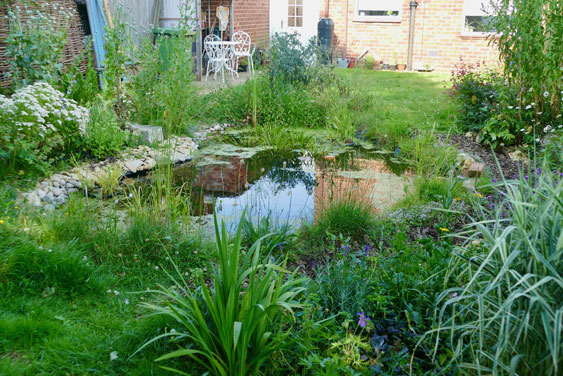
1. Make a splash with a new pond

Dragonflies need ponds as they spend around two years – the majority of their lives – as larvae in the water. You need to consider safety if you are installing a pond, particularly if you have young children, as well as location, as ponds need maximum sunshine and are best built away from trees.

2. Use rainwater

You’ll need easy access to good quality water to fill your new pond as dragonflies are sensitive bio-indicators. Mains water contains nutrients that can cause algal blooms and weed growth, so ideally fill any pond with rainwater run-off via a hose or water butt. It is best to invest in a pump with a filter if you want running water but keep it gentle as water lilies are unhappy with too fast a flow.

3. Don’t worry about size

The ideal pond size for dragonflies is 14 square metres but 3.75 square metres will do, and even a tiny raised pond on a balcony will work. Dragonflies prefer gentle gradient sides – some shallow water will be warmer and encourage larvae to emerge sooner.

A rough, slightly wiggly oval shape for your pond usually works but there is no fixed rule. Work out how you are going to reach parts of your pond, if needed, and include places to sit with large stones and a bench.

4. Think about construction

If creating your own pond from scratch, think about where you are going to put the soil. Once you’ve dug a hole, add a layer of sand beneath the pond liner for protection to avoid leaks.

Lots of preformed ponds are available online or at garden centres if you find this option easier. Fill slowly with water and then test with a pH kit to work out whether its alkaline or acidic – rainwater is typically slightly acidic.

5. Right plant, right place

Some plants thrive in flowing water, others in still. Some like acidic conditions others alkaline, so pick plants that will suit your pond’s conditions. You’ll need aquatic baskets to hold your plants and you can adjust the height of these with clean bricks laid carefully on the liner.

Choose peat-free aquatic compost and source local native water plants if possible. Why not ask a friend if they will share some from their pond? But double check what you are taking is local and not non-native or invasive. Check out the RHS website (rhs.org) for a list of suppliers.

In the water – water starwort, hornwort, spiked water milfoil.

In/on the water – greater pondweed, water lily (fringed, white and yellow), water mint, water forget-me-not.

Around the edges – flowering rush, yellow flag iris, bog bean, marsh marigold, Branched Bur-Reed.

Close to the pond – ox-eye daisy, primula, loosestrife, hemp agrimony.

6. Keep pond plants under control

Dragonflies like clear water, not overly cluttered with plants, so make sure you keep the most vigorous plants under control. Keep the water level up, particularly in warm weather. When leaves start to fall in autumn, try to keep as many as possible from falling into the pond.

7. Look out for different types of dragonfly

Emperor dragonfly – Britain’s bulkiest dragonfly, males are sky blue and females green with a central dark line.

Migrant hawker – small with paired spots along the abdomen, males are dark with blue spots and yellow flecks and females are brown with yellow spots.

Common darter – can be found well into November, males are dull to bright orange-red, and females are ochre becoming duller/reddish with age.

Black–tailed skimmer – medium-sized with a tapering abdomen, males have a blue body darkening to the rear and females have yellow with dark ladder pattern on the abdomen

Four-spotted chaser – uniformly brown dragonfly, active in late spring and summer, males and females look similar with two obvious dark spots on each wing.

Exbury Gardens in the New Forest has just been designated a Dragonfly Hotspot by the British Dragonfly Society. Visitors can learn about the insects and get close to wildlife on floating pontoons over a new dragonfly pond. For details visit exbury.co.uk.


First Drive: Land Rover Defender P400e

Land Rover has added a new plug-in hybrid setup to the new Defender, but has it helped the overall package along? Jack Evans finds out.

WHAT IS IT?

Electrification is at the forefront of the motoring industry’s concerns right now, and nowhere is that more evident than in the Jaguar Land Rover line-up. Across its range, it has begun to introduce far more electrified powertrains than before, with plug-in hybrid setups applied to all manner of the firm’s cars. Now, it’s the turn of the go-anywhere Defender.

But the Defender brings with it a whole different set of requirements. That plug-in powertrain needs to work alongside this Land Rover’s off-road tech, delivering plenty of performance and grunt, as well as those important efficiency benefits. So, how does it get on…?

WHAT’S NEW?

Outside, the Defender PHEV looks much the same as a ‘regular’ version. It’s only available in 110 layout – the batteries would’ve proved too much to pack into the smaller 90 – so there’s still plenty of space for all occasions. Boot space, however, has taken a bit of a dive, down to 853-litres with the second row of seats in place and 2,127 with second row put flat from 1,057 and 2,300-litres respectively. That said, that’s still more than enough room for most activities.

Inside, you’ve got the same combination of rugged yet high-quality materials, while the PHEV also benefits from additional readouts detailing the remaining charge left in the batteries, as well as how that electricity is being deployed in combination with the electric motor.

WHAT’S UNDER THE BONNET?

The new Defender plug-in hybrid – badged P400e in reference to the car’s power output measured in PS – hits the road as the most efficient version of the off-roader to date. Underneath the bonnet sits a 2.0-litre four-cylinder petrol engine, which combines with an electric motor and 19.2kWh battery. Together, you get a sizeable 398bhp and 460Nm of torque, equating to a 0-60mph time of 5.4 seconds and a top speed of 119mph.

In efficiency terms, the P400e should return a claimed 85.3mpg – providing the batteries are topped up, of course – while CO2 emissions stand at 74g/km. Capable of travelling up to 27 miles on electric power alone, the P400e’s batteries can be topped up from zero to 80% via a home wallbox in two hours, or seven hours with a three-pin plug. The Defender is also one of the only hybrids that can charge at speeds of up to 50kW, which would return an 80% charge in just 30 minutes.

WHAT’S IT LIKE TO DRIVE?

The added quiet and refinement that the hybrid powertrain really plays to the Defender’s strengths. It’s a comfortable car regardless, but the way the P400e quietly wafts along on its standard-fit air suspension means that it’s a genuinely relaxing car to potter around in.

The switch between electric and petrol power is hard to notice too, while thanks to its ability to travel at speeds of up to 81mph on electric power alone, you can also use that zero-emissions capability on the motorway.

That said, if the majority of your miles are conducted on the highway and at greater speeds, you may still want to consider the diesel – once the battery power has been depleted, the P400e will struggle to match the oil burner for efficiency. However, if you’re travelling shorter journeys with longer ones peppered in between, you’ll really notice the added efficiency that this setup brings.

HOW DOES IT LOOK?

The P400e looks – as you’d probably expect – just like a regular Defender. Land Rover has resisted the urge to add loads of hybrid-only design touches, with just the rear badging and charging port showcasing this as anything but a ‘regular’ Defender. In 110 layout it has a real presence, while our solid white test car had a particularly utilitarian feel to it.

The Defender’s styling has, in our eyes, been a success. It brings enough of the original’s styling touches so as to not dismiss the past, but is up to date enough to be aware of the future. This PHEV version feels particularly appropriate.

WHAT’S IT LIKE INSIDE?

The Defender’s cabin feels robust and well made. There are loads of big, chunky switches and dials which not only look good, but will no doubt prove easy to use when wearing gloves during colder months. There’s plenty of space too, with all manner of cubbies and storage areas ensuring that there’s a place for everything.

There’s the option of either five or six-seater layouts too, giving families a more flexible seating option should they need it. You’ve also got loads of charging ports dotted throughout the cabin, ensuring that everyone can charge their devices as and when they need to.

WHAT’S THE SPEC LIKE?

Defender P400e models come with a comprehensive list of standard equipment, which, considering prices start from just over £65,000, is no bad thing. All models boast 20-inch alloy wheels, air suspension and three-zone climate control. Land Rover’s excellent Pro Pilot infotainment system is included too, transforming the way you interact with all of the car’s major functions. It’s clear, simple and easy to use while the integration of Apple CarPlay is one of the most successful we’ve seen – it fills the screen, rather than settling for a small portion of it as we’ve seen on other models.

There’s more than enough equipment on board to keep most drivers happy, that’s for sure.

VERDICT

Given the performance it brings, as well as the added efficiency brought on through its hybrid setup, the P400e could be the most compelling version of the Defender on sale. Though high-mileage drivers – as well as those who more frequently find themselves towing – will no doubt lean towards the diesel versions, for everyone else this plug-in hybrid version could be a very good fit indeed.

It’s not often that a car allows you to have your cake and eat it, but the Defender P400e appears to be a rare example of this in action.

FACTS AT A GLANCE

Model: Defender 110 P400e

Base price: £65,915

Engine: 2.0-litre four-cylinder petrol with electric motor

Power: 398bhp

Torque: 640Nm

Max speed: 119mph

0-60mph: 5.4 seconds

MPG: 85.3

Emissions: 74g/km CO2

Electric-only range: 27 miles

McCarthy Holden COVID secure procedures – Updated July 2021

With the lifting of regulations on 19th July 2021, the following is an updated procedure list that we request staff and public comply with to ensure safety for all.


This is an overview of procedures that are required to be completed by all staff, owners and viewers and has been produced after a COVID secure risk assessment. If anyone would like a copy of our updated July 2021 risk assessment please email: sholden@mccarthyholden.co.uk


Offices:


When members of public enter the office, request they wear a mask and any employee of McCarthy Holden who is dealing with them must also wear a mask

Offices cleaned and sanitised regularly, especially contact points such as handles, kitchen/bathroom

Hands to be washed throughout the day and dried using paper towels which are then disposed of


Viewings:


  • Occupiers to complete preferences form with regards to who is allowed access
  • Request members of public to wear masks
  • Use hand gel/spray before and after appointment
  • Members of staff to wear mask during appointment
  • No open house viewing arrangements


Procedure during viewing –

  • Agent to use sanitiser alcohol spray on hands before entering the property and repeat at the end of the viewing. Washable and/or disposable face masks will be provided for each employee to use.
  • Request viewers to wear face masks .
  • Maintain 2m space where possible, if not possible and suitable, agent to wait outside room.
  • No surfaces to be touched – if a surface is touched it will need to be sprayed and cleaned
  • Once viewers left, agents shut up property and wipe external handles


After viewing –

  • Vendor should ensure surfaces are cleaned and towels disposed of or washed as appropriate.


Take-Ons:


  • Vendor to prepare house, turn on all lights, move anything out of sight, open all doors
  • Agent to use hand sanitiser alcohol spray and mask and wash hands before and after appointment


Market appraisals:


  • Agent to use alcohol spray and mask and wash hands before and after appointment
  • Maintain 2m space where possible
  • Doors to be opened in advance by vendor


6 simple plants that thrive on being kept indoors and are all easy to look after

If you are looking for a low-maintenance houseplant, consider these options, says Luke Rix-Standing.

Whether you’re stuck in a high rise flat, have a grass-free backyard, or just don’t fancy the outdoorsy earthiness of traditional gardening, there are plenty of pot plants that are quite happy to share your view. These plants will help you garden from the comfort of your front room…

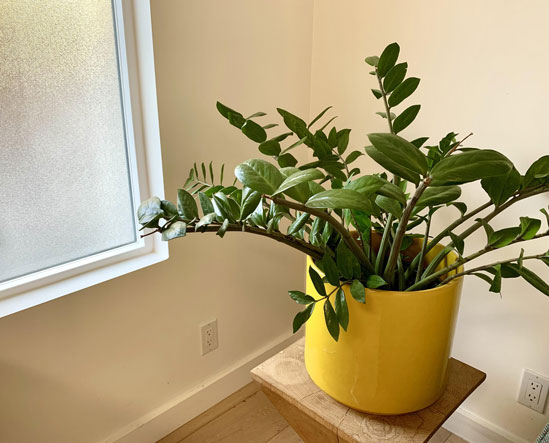
1. ZZ Plant (zamioculcas zamiifolia)

Variously known as the Zanzibar gem, zuzu plant, eternity plant and a whole host of other things, the ZZ plant is known for its smooth, shiny leaves and extremely easy care requirements.

Commonly grown in offices, this feisty foliage is as close as plants get to indestructible, and watering too often is a far more common problem than not watering enough.

A stalwart of the many houseplant collections on Instagram, the plant is highly tolerant of low light and most soil types, but is unfortunately also mildly toxic. Wash your hands after prolonged contact, and do not eat or cuddle.

2. Aloe Vera

A species that has long outgrown its status as simple houseplant, the gel extracted from aloe vera plants is widely used to soothe lesions, bites and burns, while the plant itself is known to purify the air of chemical pollutants like formaldehyde and benzene.

A succulent that enjoys relatively dry conditions, be sure not to overwater your aloe vera and place it in a sunny spot like a south-facing sill.

3. Cactuses

You probably couldn’t fit one of those trident-shaped monsters from the Atacama Desert into your living room, but there is a whole host of alternatives, ranging from small, ball-shaped cactuses to mid-sized prickly pears, that make perfect housemates.

Contrary to their reputation, cactuses do still need a teensy bit of TLC – a light water here, the occasional repot there – but overall they’re low maintenance for owners low on time or energy.

4. Madagascar Dragon Tree (dracaena marginata)

If you fancy some more formidable foliage for your home, the Madagascar Dragon Tree is a large, attractive, and realistic option. Growing (slowly) up to six feet tall, its dark, evergreen leaves, often edged with red, fan out from stems that fork from the smooth, grey-brown trunk.

A low maintenance option, it thrives in sunny spots or places that are lightly shaded but will also tolerate lower light levels. Similarly, while it likes its compost to be moist, it will put up with erratic watering and so will probably be just fine with being left alone while you’re on holiday. Cats and dog owners beware – the tree is mildly toxic to pets, and if ingested may result in an upset stomach.

5. Busy Lizzie (impatiens walleriana)

Though perhaps not the hardiest of houseplants, these floral favourites are fun for all the family because they’re beautifully bright and colourful.

You can take an eight to 12 centimetre cutting from a non-flowering stem at any time of year. After pinching off any lower leaves, pop it into a new tray filled with potting soil and, with adequate sunlight and watering, you’ll soon have a second busy lizzie. And a third, and a fourth should you wish – so they make very sustainable gifts.

6. Snake Plant (sansevieria trifasciata)

Also known as mother-in-law’s tongue or St George’s Sword, the upright, pointed leaves of this hardy indoor favourite are its main attraction – variegated with dark stripes and sometimes a yellow outline.

Growing up to a metre and a half in height (though they max out at 50 centimetres across), those with smaller homes can rest easy that they take several years to grow. Able to thrive in full sun or partial shade, and by windows facing any compass direction, sansevieria trifasciata is described by the Royal Horticultural Society as “tolerant of neglect”. Definitely our kind of plant.

Shimmer and shine: 12 ways to luxe up your decor and give your home a summer glow up

Sam Wylie-Harris puts shiny homewares under the spotlight.

There’s nothing like the glimmer of gold or shimmer of silver for a healthy summer glow – and we’re not just talking about ourselves.

Perhaps our homes could do with a touch of sun-kissed radiance too – and when it comes to streaming some summer glow into the scheme of things, the shiny options are endless.

Best of all, a little luminosity goes a long way. From gold decos to themed artwork, here’s how to polish up your pad…

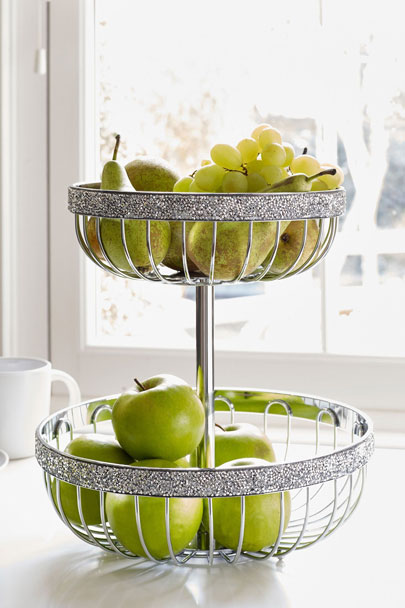
1. Harper Gem 2 Tier Fruit Bowl, £36, Next

This fantabulous fruit bowl from the new Harper Gem utensils range at Next will pimp up your pears, glam up your Golden Delicious and make everything taste that much sweeter.

2. Pols Potten Hourglass Ball Sandglass Mini, Gold, £20, John Lewis

Ah, the sands of time. Measuring up to 30 minutes, watching the golden sand flow through this globe is the next best thing to footprints in the sand.

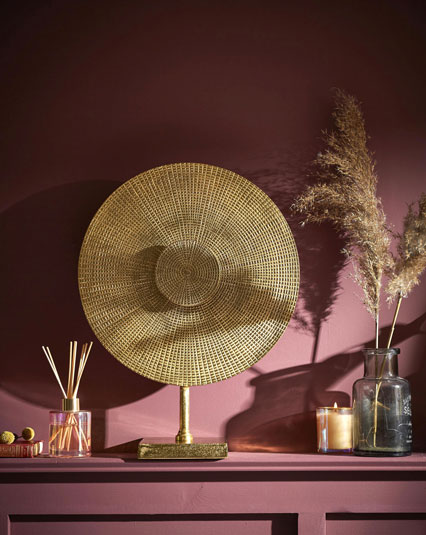
3. Golden Standing Deco, £40, Joe Browns

This stunning sphere, with intricate hammered detailing looks like something you’d come across in a luxe hotel. One for your deco edit, if you’re after something divine and dramatic.

4. Wild & Wolf Retro 746 Telephone, Brass, £69.95, Amazon

Dial M for Minted… If you want to dial up a sideboard or retro telephone table, this push-button phone has your number.

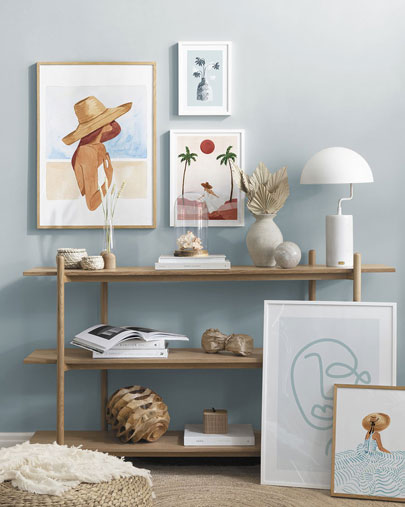
5. Summer Art: Emmaline Poster (left), from £8.42; Madam Fleur No 2 Poster (bottom right), from £8.42 (other artwork from a selection), Desenio

For pure escapism, a ‘wellbeing’ wall panelled with your favourite prints – think floaty sundresses, wide-brim beach hats, golden sands, palm trees and artfully placed holiday trinkets – will make you feel happy, creative and channel your inner glow.

6. George Monkey Table Lamp In Metallic Gold, £45, Iconic Lights

Troops of monkeys are trending in interiors, and this playful little fellow is a fun find.

7. Marle Wine Cooler, £125, Ella James

Beyond spoiling yourself, if you’re on the hunt for a wedding gift or want to spark up a special celebration, this classy cooler will dress up a cocktail trolley. The hammered silver brass catches the light beautifully and will sit well with anything glossy… Bring on the bubbly.

8. Large Gold Effect Winged Foot Planter, £65, Rockett St George

With a nod to the Greek gods, this heavenly piece knows no boundaries and will look just as fabulous in your garden room or patio, as bookending your favourite novel. Fill will flowers, herbs or a pillar candle.

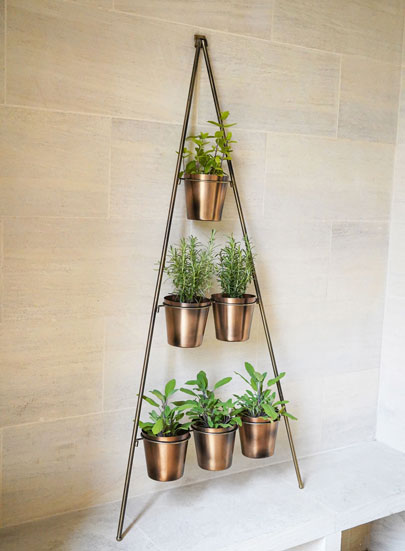
9. Vertical Wall Plant Stand With Planters, £139.99, Ivyline

If you’re shelves are drowning under the weight of your #shelfie succulents, this vertical plant stand could be just the ticket. With six gold metal containers to show off your greenery, it’s rust-resistant and suitable for indoor and outdoor use.

10. Gatsby Birdcage Nest of Tables, £279, Cuckooland

You can never have too many tables, especially if you’re still working from home or more ‘cluttercore’ than minimalist – and constantly in need of extra surface space to show off your things. With their antique gold finish and art deco style, these Gatsby tables will make everything look that much lovelier.

11. Metallic Fan Cushion, £12, Next

A steal at the price, this shimmery scatter cushion is one to snap up now.

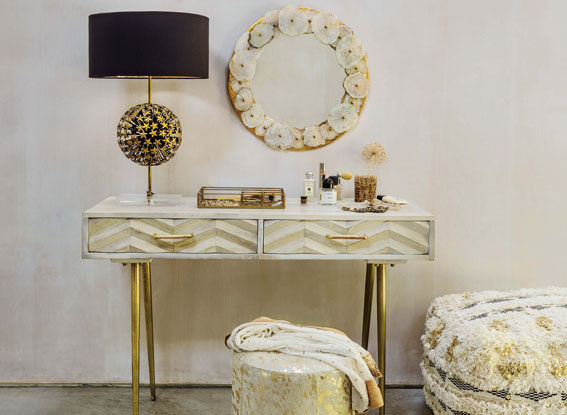
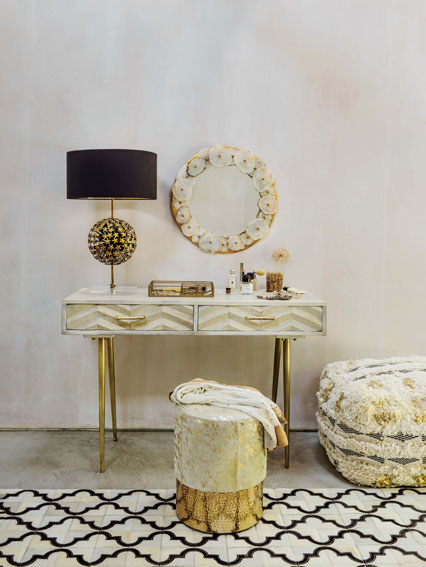
12. Gold Cowhide Vanity Stool, £250; Ariella Chevron Desk, £595 (other items part of room set), Graham & Green

Sophisticated and practical, this ‘gilty’ pleasure will satisfy your inner diva and sit pretty wherever you place her. And if you really want to go for gold, the desk doubles up as a dressing table.

8 simple ways to cool your house down during a heatwave

When the weather heats up, you want your house to be a haven of coolness. Here’s how to achieve that. By Luke Rix-Standing.

We’re already one heatwave down, and there’s probably more to come, but summer can prove tricky when we’re away from air-conditioned offices, and escaping abroad for a week by the pool still isn’t guaranteed.

Here’s how to keep your house cool during the summer swelter…

1. Get a fan

Fewer than one per cent of UK homes come equipped with air conditioning (and most of the time we all know why), so if you want cold air blowing your way, a plug-in fan is likely the easiest way to go. They only provide temporary respite, but on a really hot day temporary respite is more than enough.

For added freezy feelings, place a bowl of ice or iced water in front of your fan, which will help cool the air the fan blows in your direction.

2. Sleep with cotton sheets

Put away the duvets, quilts and bedtime blankets, cotton should be your sheet material of choice during long hot summer nights. Even more breathable than satin and silk, light-coloured cotton bedsheets are probably the coolest coverings you’ll find. And if things get really, unbearably hot, try popping sheets in a plastic bag and stashing them in the freezer for a bit, before putting them back on the bed for super cool sleep.

3. Close the curtains

Closed curtains and blinds are often associated with stuffiness, but by exposing all your windows at the start of a scorching day, you can basically trap yourself in an enormous greenhouse. Black-out blinds are especially effective at blocking incoming rays if you’re willing to opt for something a little more heavy duty.

4. Seal any gaps

You’re looking to physically block as much heat as possible from entering your home, and some surprisingly blunt methods might help you do so. Towels or draught excluders can do the trick around doors and windows, while DIY enthusiasts can close up any cracks in the masonry with off-the-shelf sealant.

Keep your windows closed during the day, and only open them to let in cooler air overnight. If you must engage in daytime window-opening, make sure you open windows on either side of the house, and keep doors open to create a through-draught.

5. Invest in house plants

House plants can help permeate a stuffy room with moisture, and window sill staples like rubber plants, snake plants, and peace lilies can help create a more breathable microclimate. Some indoor-friendly flora even sucks up pollutants and particulates – aloe plants spring to mind – potentially helping you deal with the heat a little more easily.

6. Turn off your tech

Appliances give off a surprising quantity of heat, particularly while charging. Power down computers and televisions rather than leaving them on standby, and try to leave plenty of space behind fridges and freezers for ventilation. If your laptop is actually on your lap, you’ll be able to feel the heat very directly, and if you can, it might be wise to periodically switch it off during your day.

7. Engage in cooling activities

It’s not exactly rocket science, but cold drinks can cool you down; damp cloths can cool you down; and cold showers can cool you down a lot. Ice your wrists, pop your feet in a bucket of cold water, eat a lot of ice lollies – you have options.

8. Turn off the lights

The marginal heat loss benefits do not outweigh stubbing your toe, so still flick the light switch if going for a bathroom break after hours, but light bulbs do emit heat as well as light, and a naturally lit home tends to be a cooler home.

Green mortgages: What are they and what are the benefits?

Thinking of making home improvements, or buying a more energy-efficient home? Green mortgages may be able to help, writes Vicky Shaw.

Many of us are trying to do more to help the environment nowadays. Perhaps you’re trying to reduce your household waste, recycle more, and find more eco-friendly places to buy items from.

And if you’re a homeowner, there could be some upgrades you can make to your property, to make it a bit more eco.

You may need to borrow more money to make your home ‘greener’, or you may be buying a home with a high energy efficiency rating – and that’s where green mortgages can come in.

Sustainable home improvements can be good for your wallet, as well as the environment. For example, someone could potentially save on their heating bills over the long term by having their windows replaced or reconditioned.

And with green mortgages, you may also find you can get a lower borrowing rate.

To find out more about green mortgages, we talked to James Pagan, head of mortgages at Nationwide Building Society…

What are green mortgages?

Pagan says green mortgage products tend to either encourage people to make their existing property more energy-efficient, or reward them for buying a property with a high energy efficiency rating.

In terms of mortgages which help people make their existing property greener, he adds: “A lot of people don’t necessarily buy a house on its energy efficiency. They buy it for other factors, such as location, space, garden. And once they get in there, they often think: ‘OK, well how do I make the most of the home that I’ve bought?’”

What sort of home improvements can green mortgages cover?

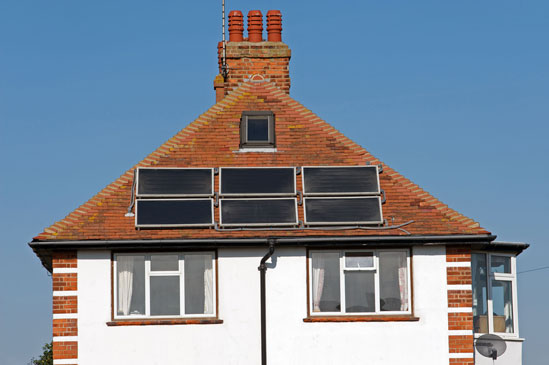
This could depend on the individual lender, but Nationwide’s Green Additional Mortgage can be taken out for a wide variety of upgrades – including new or upgraded windows, solar panels, boiler improvements, insulation including pipe and boiler insulation, air source heat pumps, electricity or lighting upgrades, rainwater harvesting, electric car chargers and small-scale wind turbines.

One couple from Bolton in Lancashire, for example, borrowed £25,000 to improve their home and installed a new warm, insulated roof on their orangery.

What green mortgages does Nationwide offer?

Pagan says Nationwide has a Green Additional Borrowing mortgage for existing members, who already have a mortgage with the Society. The fee-free mortgage has the Society’s “best” rate, at 0.75%, and people can borrow up to £25,000, depending on individual circumstances. The deal is available at up to a maximum of 85% loan-to-value (LTV) and the 0.75% rate is the same for all eligible borrowers, regardless of the LTV.

To qualify, at least half (50%) of the additional borrowing must be spent on energy efficient home improvements. The mortgage term of the additional borrowing can’t be longer than the existing main mortgage term.

And for existing or new members buying homes with high energy efficiency ratings, the Society offers cashback of up to £500 under its Green Reward scheme. This is available for existing homes and new-builds and flats as well as houses, with further details about the criteria on Nationwide’s website.

The schemes are part of the Society’s commitment to ensuring 50% of its mortgage book is rated EPC-C or above by 2030. Landlords can also benefit, with Nationwide’s buy-to-let arm, the Mortgage Works offering Green Further Advance mortgages for landlords.

Why has Nationwide introduced green mortgages?

“It’s linked into our core purpose, so we were created as a building society movement to get better quality housing for everyone,” says Pagan. “Take-up is improving all the time.”

The Society has also been working to minimise its own environmental impact, and is now carbon neutral in energy use and emissions for all internal operations and company vehicles, and uses 100% renewable electricity.

What other deals are on the market?

While the popularity of green mortgages could increase in future, Rachel Springall, a finance expert at Moneyfacts.co.uk, says products are still “rather niche” across the market generally.

“But some major lenders are already on board to offer a discounted mortgage rates to borrowers who purchase an energy-efficient home,” Springall adds. “This fact alone provides much optimism for more lenders to offer a similar approach.”

She highlighted Virgin Money, which recently launched Greener Mortgages – offering lower rates of interest to customers buying energy efficient new-build homes.

In a survey, Virgin Money found tackling climate change is important to 78% of people, and the pandemic has made over a third (34%) think more about their environmental impact.

NatWest has also launched Green Mortgages, offering discounted rates to those purchasing an energy efficient property.

Springall said: “It is vital borrowers seek advice when comparing deals, to ensure they can meet eligibility criteria and not be left disappointed.”

5 ways to make sure that you are heading for a comfortable retirement

Unsure whether your savings will be enough to be comfortably off in retirement? Here are some expert tips to help give you an idea.

Would you shrug your shoulders if you were asked if you’re on track for a financially comfortable retirement – or would you be confident that you know the answer?

According to Which?, couples typically need an income of around £26,000 per year in retirement to live comfortably, while those who are single need around £19,000, including state and private pensions.

And many people are some way off their retirement targets, as separate research from Fidelity International found that while women expect to retire with an annual income of £33,980, this is significantly higher than the £70,052 the average women over 55 has saved into her pension pot.

Those who are unsure about their retirement options may want to speak to the free, Government-backed Pension Wise guidance service or get independent financial advice.

In the meantime, to help give people an idea of whether or not their plans are on track for the retirement they want, here are some tips from Maike Currie, investment director at Fidelity International.

1. Establish what you already have.

If you’re not sure whether you are in your workplace pension scheme, ask your employer. They will be able to provide the details of the pension provider and help you view your savings. From there, you’ll be able to track how much you and your employer are contributing each month.

If you’ve worked at multiple companies, you’ll probably have multiple pensions. These can sometimes be difficult to track down on your own, but the Pension Tracing Service can help you and it’s free of charge.

2. If you’re self-employed start a pension early.

Try to think about your pension as soon as you start earning money, particularly if you’re self-employed. According to Office for National Statistics (ONS) figures, self-employed workers aged 35 to 54 are more than twice as likely to have no pension wealth than those who have an employer.

You could consider self-invested personal pensions or Sipps. Like an employee with a workplace pension, you can still benefit from tax relief on pension contributions.

You don’t need to have a significant amount in order to open a Sipp, in fact you can put in as little as £25 a month into your Sipp with Fidelity.

By contributing to your pension early in your career – no matter how much or little you are putting in – you will benefit over time. This means the money you contribute in your 20s and 30s could be worth significantly more by the time you hit retirement (bear in mind the value of investments can go down as well as up).

3. Take ownership.

It’s your pension. Make sure you understand where your contributions are going and think carefully about how to maximise them. If you are an employee in your company’s pension plan, your contributions were most likely invested into a “default investment”.

These tend to be broadly suitable for most people, but some want to explore alternative approaches and funds that are better suited to their goals. A financial adviser could help if you are unsure about this.

It is also worth finding out whether your employer is willing to make contributions above the statutory minimum levels. Some will offer to match further contributions you make.

4. Set yourself up for a financially ‘worry-free’ retirement.

Everyone’s dream retirement will look different. The amount you need to save for your retirement will largely depend on what you want to use it for.

Start by working out your current day-to-day outgoings, then consider how often you’ll want to go on holiday and afford other luxuries. Make sure to also consider the cost of care, whether you plan to leave money to loved ones, and life expectancy to ensure your pension will last. Once you understand what you’ll need for your retirement then you’ll have a goal to aim for. Again, if making those calculations seems daunting, a financial adviser can help.

5. Finally, be aware of the pensions gender gap.

Women often face a significant gender pensions gap. The gender pay gap, being more likely to take time away from work to look after family, and a propensity to invest less all contribute to the gap but there are steps that women can take to close it.

For example, if you’re taking time off work to have children you could increase your contributions when you return, or even get your partner to contribute on your behalf. Fidelity’s research found that if women contributed 1% more of their salary each month, they could close the gender pension gap by retirement.

7 important tips for designing a kitchen you’ll absolutely love

Want to start the summer with a fresh, updated, modern kitchen? Liz Connor hears spend-smart tips from the experts.

Full-scale kitchen renovations can be expensive, which is why it’s important to make sensible, practical choices during the planning stage, that you won’t regret in the long-run.

While it’s tempting to opt for style over substance, the kitchen is arguably the most important room in the house, and for many families, it’s a space that needs to function as an office for homeworkers, an entertaining hub and a stand-up breakfast spot.

Consider these tips when planning your revamp for a space that’s both beautiful and functional…

1. Suss out your storage needs early on

“If you’re partial to a crockery collection or two and have a pantry bursting with exotic ingredients, storage is going to be particularly important,” says Stephen Lynskey, head designer at Hammonds Kitchens (hammonds-uk.com). “What many people don’t realise is that storage options are decided right at the beginning of a kitchen plan, when the blueprint is being mapped out.

“Think about whether you need more drawers or cupboards, whether a display unit is specifically important and how big your pantry needs to be at this stage, to avoid disappointment later down the line.”

2. Lighting is really important

“Lighting is so important when creating a cosy atmosphere in a kitchen. I recommend focusing on three different kinds when creating your perfect setup: top lighting, task lighting and ambient lighting,” advises Lynskey. “All three need to come together perfectly to create the mood you find most relaxing.

“Thinking about where to have shadows and where to cast light can have a surprisingly large effect on the feel of a kitchen. Aim to shed light on the parts of the kitchen you will use regularly, such as the cooker and worktops, but play with shadows in the rest of the space to create an atmospheric and zen place to relax.”

3. Opt for matt cupboards if you have small children

Lynskey continues: “Nobody wants jammy hands all over their kitchen cabinets. Choose a matt finish as opposed to gloss, as they are easier to clean and disguise visible marks better.

“Matt also has a timeless appeal, so your kitchen will remain fashionable for years to come.”

4. Go for practical materials

Laura Davie, marketing manager for Cosentino UK (cosentino.com) says: “Consider a kitchen surface that’s suited to your lifestyle and the way in which you use the kitchen.

“For instance, keen cooks will benefit from a heat and scratch resistant surface, such as a composite surface. It’s ideal for those wanting to recreate a specific look, such a marble or wood, without wanting to worry about the hassle of maintenance.

“As for splashbacks, composite surfaces offer the opportunity to use a large, single slab splashback, making a real design centrepiece, while being easier to clean with no awkward tile grouting.”

5. L-shared islands are great if you like socialising in your kitchen

“If you’re the type of household that loves having gatherings in your home, thinking about elements such as seating in the kitchen, is essential,” says Lynskey.

“Kitchen islands are a great opportunity to create a sociable space, but rather than having seating down just one side, why not opt for two sides so that your guests can face one another when socialising? For this, I recommend an ‘L’ shape, rather than the standard square. ”

6. Get an expert involved

Bella Glenn, design expert at Benchmarx Kitchens And Joinery (benchmarxkitchens.co.uk) says: “I would always recommend getting an expert planner involved in your kitchen design early on, to ensure you maximise the features that are important to you.

“There’s a wealth of knowledge available at kitchen retailers, who are best placed to discuss ways to achieve a bespoke look. Many manufacturers will have options available that can replicate a look at a range of price points, so if you have a style in mind, then it’s certainly worth talking this through.”

7. Accessibility matters

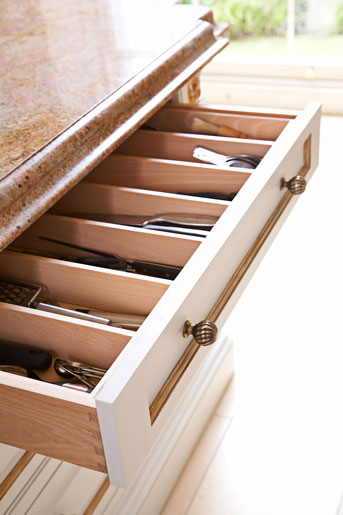
“Accessibility is of utmost importance when designing a kitchen for older clients, or those with elderly relatives,” stresses Lynskey. “Doorknobs may prove troublesome for arthritic hands, so larger handles that can be easily grasped are a better option. Soft closing doors and drawers make for one less thing to worry about and give the kitchen a luxurious feel.”

He adds: “Lighting also needs to be a key consideration, as it must be bright, easy to find and operate. For this, opt for a one-switch policy that controls all lighting, to avoid confusion. “

Local Craft Creation Hartley Wintney

McCarthy Holden introduce local craft work

In the conduct of McCarthy Holden’s day to day activities we meet people from all walks of life and from time to time we discover people with great craft talents and skills, so in this news article we are highlighting the unique products created by Maggie Sheerman who lives on the outskirts of Hartley Wintney.

Below are samples of her work created by Maggie from her workshop on the Bramshill / Hartley Wintney borders. We are also listing the prices of some of her work as well as her contact detail for you to purchase direct from her.

McCarthy Holden introduce local craft work

These reclaimed pine or oak door stops with bullet cartridge heads, with a heavy duty ring handle are available from £20 to £45.

McCarthy Holden introduce local craft work

The reclaimed oak key fobs with cartridge heads are available from £5 to £9.

McCarthy Holden introduce local craft work

Polished oak key racks with brass bullet hooks are available in various sizes and priced from £25.

McCarthy Holden introduce local craft work

Reclaimed wood wall art with wine / champagne corks are available from £85

McCarthy Holden introduce local craft work

Reclaimed oak lamps with bullet cartridge heads and light stem (shades extra) are available from £180.

McCarthy Holden introduce local craft work

Reclaimed oak mirrors in various sizes (ornament excluded) are available from £45 to £180.

McCarthy Holden introduce local craft work

Serving tray / mat with wine / champagne corks are available from £35.

McCarthy Holden introduce local craft work

Reclaimed wood key racks with bullet cartridges or antler tips are available from £35 to £65.

McCarthy Holden introduce local craft work

Reclaimed oak key racks with brass bullet cartridges are available from £25 to £65.

How to purchase or commission a bespoke craft item.

If you are looking for something unique or interesting, beautifully crafted locally then contact Maggie Sheerman on 07770 624443 or email at maggie.s@btinternet.com

Product photography by johnjoe.co.uk

×
Find a Property
M
Country & Equestrian
By submitting this form, you agree to McCarthy Holden using your personal data in accordance with our Privacy Notice.