TV presenter Matt Baker on Channel 4’s National Trust: Our Dream Farm.

Matt Baker editorial McCarthy Holden

By Yolanthe Fawehinmi, PA…

Matt Baker’s dream farm looks like the traditional hill farm he grew up on in the Durham Dales.

But when the 47-year-old British TV presenter thinks about the 600-acre farm in Eryri, (formerly Snowdonia), North Wales, that tenant farmers (people who rent land from a landlord and work the land) compete for in the second season of Channel 4’s National Trust: Our Dream Farm With Matt Baker, it’s a close second.

“I’m very fortunate to have grown up on a very traditional hill farm in Durham Dales. That’s the farm that I love. I love a mixture of landscapes as well. Welsh farms are very similar to the kind of farms that we have in the Durham Dales, but thankfully, my dream farm is the farm I grew up on,” says Baker, a former presenter on children’s television show Blue Peter from 1999 until 2006.

“It’s the world I know and love. It’s where I feel comfortable in that kind of landscape with lots of dry stone walls and older buildings, but also more modern buildings that you can drive tractors in and get all of your stock in if needs be. I love a hardy, rugged farm with a good yard and some modern barns.”

In the documentary-style series, seven shortlisted candidates are put under the watchful eye of the National Trust as they complete real-life farming tasks in the hope of becoming the new tenants of a unique hill farm in the national park, with a four-bedroom farmhouse at its heart, for the next 15 years.

Matt Baker editorial McCarthy Holden
Photo from National Trust: Our Dream Farm with Matt Baker and contestants.

The National Trust have a lot more applicants for their farms than they have to give.

So in National Trust: Our Dream Farm With Matt Baker, contestants will be judged on how well they maximise the opportunities that the farm has to offer.

This can be anything from tourism, how innovative or business savvy they are to how they prioritise environmental sustainability.

Across eight episodes, prospective tenants will be eliminated one by one until only two hopefuls are left and invited to have a final meeting with the National Trust. But only one person can win and become the proud owner of the farm.

“For me, any show that puts our agricultural world front and centre is absolutely vital, as far as I’m concerned. Not a lot of people know of the world of tenant farming, and the fact that a third of British farmers are tenant farmers. I think you only have to go out into the countryside and be so thankful that it looks the way that it does because of our farmers,” says Baker, who shares two teenage children, Luke and Molly, with his wife, physiotherapist Nicola Mooney.

“Not only are they producing our food, but they’re looking after our environment. I think we should shed light and can gather as much support as possible for the farming community, and show people what goes on and how challenging it is.

“Our farmers have to be jacks of all trades, you got to be so independent, and they’re providing all of the time. People need to be more grateful to our British farmers for producing our food and looking after our environment. In my eyes, it’s our farmers that make Britain what it is.”

From 2009, Baker looked into people, places and stories making news in the British countryside, whilst he co-presented BBC One’s Countryfile.

The following year, he stood in for English comedian and presenter Jason Manford, 43, as a guest presenter on BBC One’s magazine programme The One Show.

But when Manford resigned in November 2010, Baker was promoted to a more permanent position as a co-host with Welsh TV presenter Alex Jones, 47 – the same year he came second place on the eighth series of Strictly Come Dancing with Russian-Kazakh ballroom dancer Aliona Vilani, 40.

In the first episode of the new Channel 4 series, Baker says that if he were the winning tenant of the farm, he would be bursting with ideas and know exactly where to start.

Matt Baker editorial McCarthy Holden

“What is unbelievable is that the lake [on the farm] is where the legend of the red dragon from Wales comes from, which is incredible. There’s a legend that’s told actually in the series where the white dragon and the red dragon had a battle, and basically, the white dragon leaves and the red dragon remains. And that’s why the Welsh dragon is on the Welsh flag, it comes from that lake, which is just unbelievable,” he says.

“So I would certainly feature that heavily, I would key into that because a farm like this is so hard to come by. It’s one of the most nature-rich farms the National Trust have in Wales.

“I’ll certainly keep up with all of the grazings they do up on the mountain pasture, honestly, the nature there is everything. I love that side of things as well.

“But I’d be welcoming people from all over to come and immerse themselves in that kind of world. I would certainly lean into all of the heritage that’s there, including the walling. There are a lot of foundations around the 600 acres that reflect the things that have gone by over the years and the way that the shepherds used to work the land. So I’d look at reinstating some of those.

“I’d also keep on with those heritage animals, the stock that’s there, the Welsh Black cattle and the mountain sheep. I would run it very traditionally, but I’d invite people to come and experience that world.”

So what misconceptions does Baker think people have about countryside life and farming?

“It’s maybe a bit rose-tinted,” Baker admits. “It’s not as bucolic as people imagine. Our countryside goes on in winter. The tougher months are really challenging. People think things only happen in springtime, when the birds are tweeting and the flowers are out, the lambs are bouncing around.

“But let me tell you, it’s very hard work, it’s a tough life, and it’s not a job, it’s a lifestyle. Families are wrapped up in this constantly, and they work together. I think the togetherness and the community are very strong in the rural community.

“I think the biggest misconception is that people don’t understand where our food comes from or how it’s produced and the effort level. You only have to try and grow cress (an edible herb) on the window, think about a bit of food production, and then ask yourself the question, are you still doing it?

“And if you’re not still growing cress on the window, why not? A lot of people can’t be bothered, so be thankful to the people that are producing your food.”

National Trust: Our Dream Farm With Matt Baker cames to Channel 4 on Saturday, March 15

Saturday Kitchen’s Matt Tebbutt: TV bloopers and three great recipes

Saturday Kitchen’s Matt Tebbutt editorial at McCarthy Holden

BBC Saturday Kitchen star Matt Tebbutt says one of his biggest challenges is not swearing because “you forget you’re on TV” – and over eight years he’s made a few blunders.

“You have to remember you’re on telly, and you can get very comfortable and act and say things you would in your own kitchen with your friends – you could easily swear, because I’m quite sweary” says the 50 year old, who replaced James Martin as presenter in 2016.

“I called Peter Gordon [a New Zealand chef] an f****** genius, under my breath. I had to apologise, I was mortified.”

Funnily enough, Tebbutt says he later received an email from Gordon’s PA thanking him for the mention on Saturday Kitchen in 2017. “[They said], ‘Our website has crashed, would you like to come for lunch?’

“I was told off quite rightly, but since then, I always try to have a little word myself before [going live].”

Tebbutt says that while the guests do wine tastings alongside tucking into the dishes cooked up on the show, he’s careful with alcohol while on air.

“What I’ve realised very quickly is that if I drink half a glass of wine, suddenly the autocue moves around, you’re not very good at linking words together. So if I drink like a centimetre of wine in the whole show, I’d be surprised.

“We taste a lot in rehearsals,” he adds.

Saturday Kitchen’s Matt Tebbutt editorial at McCarthy Holden
Matt Tebutt

Tebbutt has just released his latest cookbook, Pub Food, a collection of elevated pub dishes – think mussels cooked in beer with crispy monkfish cheeks, and rump of Welsh lamb with spiced aubergine, mint and yoghurt – as well as a celebration of British pubs in general.

They are “one of the last melting pots there are in life”, says the chef, who also presents Food Unwrapped on Channel 4. “I will disappear on a Friday and go and do Saturday Kitchen. And then I’ll meet some quite famous faces sometimes, get back to the pub [near his home in Monmouthshire], and nobody gives a monkey’s! They really don’t care, and it’s great.

“You can be in the same place with very wealthy people and farmers, and the guy who empties the bins, all on the same level, and you’re all having a chat- there’s very few places you can do that anymore.

“Then if you throw good beer and conversation in the mix, and good food, I think they’re really special places.”

But local pubs are “having a really s*** time at the moment”, Tebbutt says. “They are struggling, the prices are going through the roof, energy costs, food costs, staffing. It’s all hindering the growth – they’re shutting by stupid numbers per week. I think it’s a real shame and it’s something worth trying to save.

“People need to remember that they’re not going to always be there. And if you’ve got a good one then go and support it.”

Tebbutt and his wife Lisa ran the Foxhunter Inn, Monmouthshire, for 14 years, where they championed sustainable, local fare – something that’s still his M.O. “In the mid Nineties [when working in London] seasonal and local weren’t really such a big thing. Then I moved out, set up my own place, and it seemed obvious because A, it’s going to be cheaper, and B, it’s going to be at its best.”

People are “much more in tune” with sustainable eating now, he notes.

Many of the recipes in the new book are influenced by the local produce of Monmouthshire and what he used to be on the pub menu. “Obviously, [there’s] a lot of lamb, a lot of mushrooms through foraging, crayfish dishes – because we get crayfish in the rivers – wild samphire, eel, black pudding,” Tebbutt says.

Eventually, he burned out running his own pub. “It was a very different sort of relentless business. We didn’t take a break – we did it for 14 years. I was juggling TV and the restaurant for quite some time, and then reached a point where I didn’t think it was sustainable, because I was knackered.

“Little country pubs, as lovely as they are, and everyone wants them on their doorstep, they’ve got to be supported because they’re bloody hard work to keep going.”

Tebbutt originally learned his trade in Michelin star kitchens in London, training under Marco Pierre White and Sally Clarke. And despite having to get up at 5am to film Saturday Kitchen, the hours are “a walk in the park” compared to life in a professional kitchen.

“When I first got into TV and you do 10-hour days or something, and you’d have people saying, ‘Are you OK?’, ‘Do you need to sit down?’, ‘Do you need a drink?’ – no, I’m fine! When you’re used to working 18-hour days in sometimes horrible conditions, everything [else] is a breeze.”

Tebbutt was first attracted to life in the kitchen after reading White Heat by Marco Pierre White when he was 16. “It just made chefs look really cool and sexy and really, really rock and roll. It was the first cookbook that had this dirty-looking, kind of rugged chef producing the most beautiful place of food.

“That juxtaposition between the sweat and the blood and tears at the back of house and the control at the front – I just kind of fell in love with it.

“Kitchens, they’re a bit like joining the army. You go in at the bottom, you keep your head down, you find your way and you slowly build yourself up. It’s brutal but you learn a lot.”

But some head chefs do take it too far. He remembers going to eat in one restaurant when he was working in London by a very famous chef at the time; “They had an open door and we saw this chef absolutely, continually tearing his kitchen staff apart. To the point where it was all heads down, they looked broken.

“And then you get the food, it looks beautiful, but you don’t want to eat it because of the misery that’s gone into it.

So now, “I don’t like the chef, I won’t eat their food.”

Matt Tebbutt’s Pub Food by Matt Tebbutt is published in hardback by Quadrille on August 29, priced £26. Photography by Chris Terry.

Saturday Kitchen’s Matt Tebbutt editorial at McCarthy Holden

And Now Some Recipes From Matt

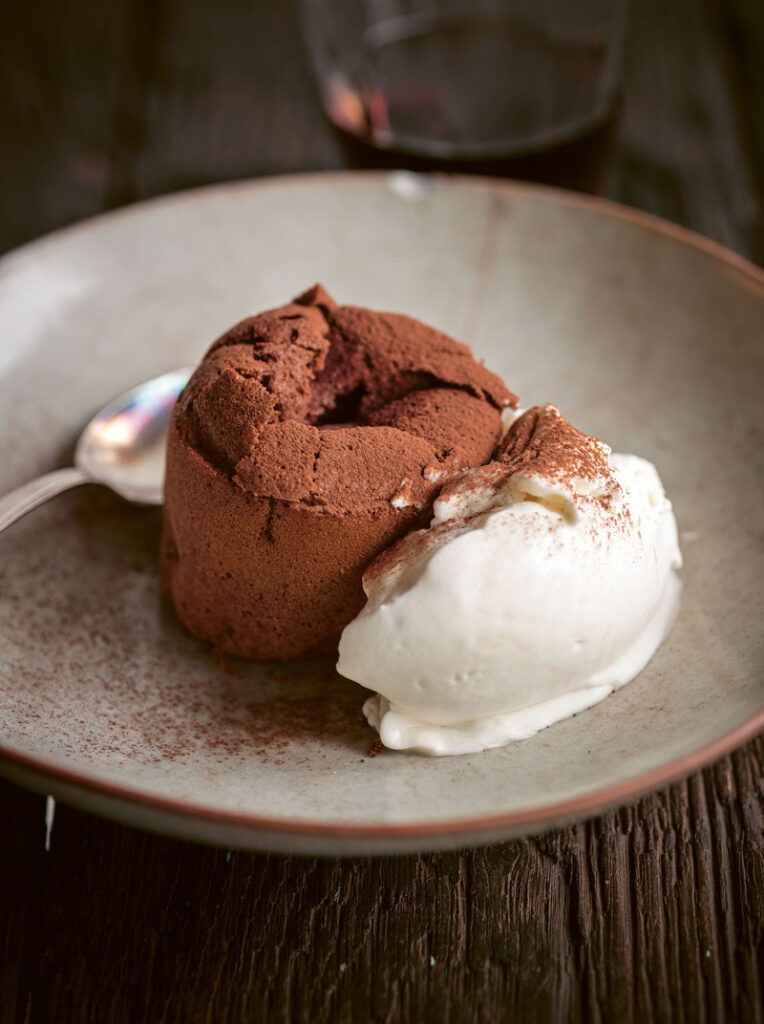
Matt Tebbutt’s chocolate pudding and mascarpone ice cream recipe

By Lauren Taylor

“This is quite a light, delicate chocolate cake, with a deliciously molten interior. The star anise is optional if you’re not a fan,” says TV chef Matt Tebbutt.

Chocolate pudding and mascarpone ice cream

Ingredients

(Makes 10-12 little puddings)

For the mascarpone:

350ml water

150g caster sugar

Finely grated zest and juice (about 75ml) of 2 unwaxed lemons

400g mascarpone cheese

For the chocolate puddings:

250g dark chocolate, broken into pieces

250g unsalted butter

125g caster sugar

1 tsp freshly ground star anise, sieved (remove the seeds from the pod, and crush in a pestle and mortar), optional

5 medium free-range eggs

5 medium free-range egg yolks

50g plain flour

a pinch of salt

Good-quality cocoa powder, to serve (optional)

Method

1. Start both the ice cream and cake the day before. For the ice cream, simply boil the water, sugar and lemon zest in a saucepan. Once the sugar has dissolved, remove from the heat and stir in the mascarpone with the lemon juice. Cool and chill in an ice-cream maker (be careful not to over-churn). Freeze in a suitable container.

2. For the chocolate pudding, melt the chocolate and butter in a bowl over a saucepan of hot water. In a bowl, whisk the sugar, powdered anise, whole eggs and egg yolks until light and pale. Slowly add the melted chocolate to the egg and sugar mixture. Carefully fold in the flour and salt. Pour the mixture into little 200ml non-stick moulds, filling them halfway. Chill in the fridge overnight.

3. Next day, preheat the oven to 180°C/350°F/Gas 4.

4. Remove the pudding batter from the fridge, bring to room temperature and bake in the preheated oven for 10 minutes, no longer. The outside of the cake mix should be set firm yet the middle will remain molten.

5. Serve the cake hot with the mascarpone ice cream and a dusting of cocoa powder, if liked.

Saturday Kitchen’s Matt Tebbutt editorial at McCarthy Holden

Matt Tebbutt’s smoked haddock souffle tart

By Lauren Taylor

“Lighter than a traditional quiche, but just as satisfying. Always source naturally smoked haddock,” says TV chef Matt Tebbutt.

Smoked haddock souffle tart

Ingredients

(Serves 4)

2 smoked haddock fillets

1.5 litres whole milk

1 bunch fresh dill, chopped

60g unsalted butter, melted

50g strong Cheddar, grated

1 tbsp crème fraîche or double cream

3 free-range eggs, separated

1 ready-made 22cm round shortcrust pastry case

Salt and pepper

To serve:

Mixed green salad dressed with olive oil and lemon juice

Lemon wedges

Method

1. Preheat the oven to 200°C/400°F/Gas 6.

2. Place the haddock and milk in a large saucepan and poach for 8–10 minutes or until cooked through.

3. Remove the fish, leave to cool and break the haddock into flakes. Place the haddock in a bowl and stir in the dill, melted butter, cheese and crème fraîche and season with salt and pepper. Add the egg yolks and mix to combine.

4. In a separate bowl, whisk the whites until stiff peaks form. Fold the egg whites gently through the haddock mixture.

5. Spoon the haddock mixture into the tart shell and bake for 35 minutes or until the filling has risen and the pastry is golden.

6. Serve the tart in slices with a green salad, and a lemon wedge for squeezing over.

Saturday Kitchen’s Matt Tebbutt editorial at McCarthy Holden

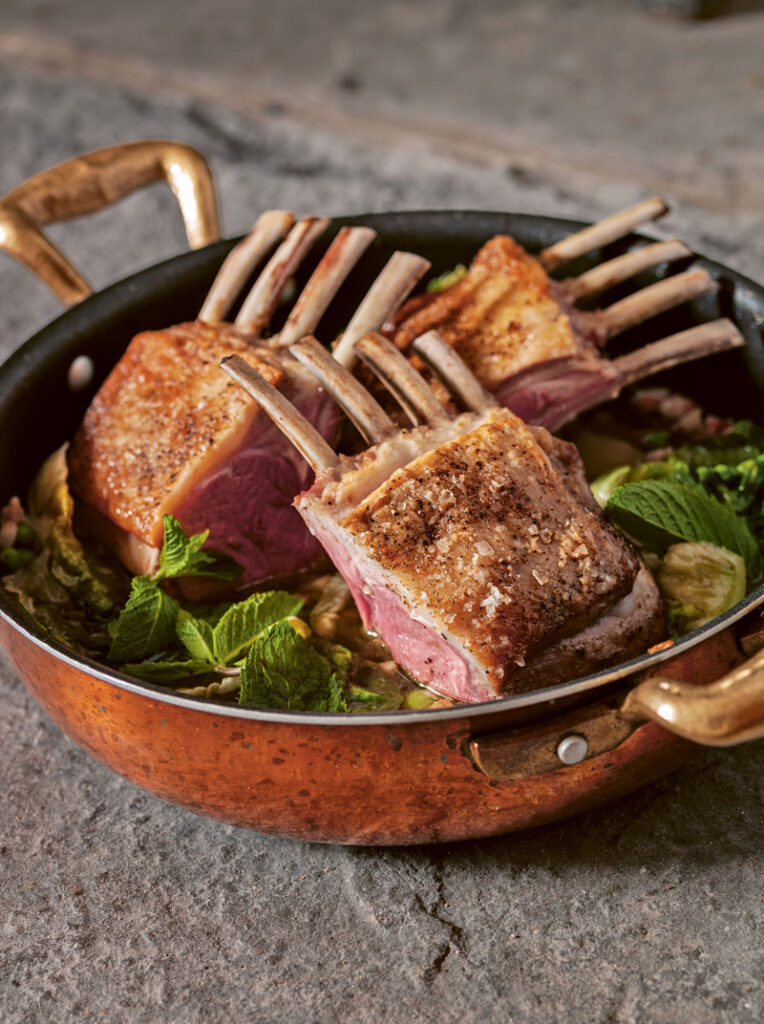
Matt Tebbutt’s rack of lamb recipe

By Lauren Taylor, PA

“I don’t really need to comment much on this one – it’s heavenly, early summer on a plate!” says TV chef Matt Tebbutt.

Rack of lamb with baby gem lettuce, peas, mint and bacon.

Ingredients

(Serves 4)

Olive oil

2 x 8-bone racks of lamb

Salt and pepper

4 sprigs fresh thyme, leaves picked

75g unsalted butter

4 medium baby gem lettuces, halved

200g pancetta or bacon, diced

4 garlic cloves, peeled and thinly sliced

100g fresh shelled peas, blanched and refreshed

800ml lamb stock

4 sprigs fresh mint, leaves picked and torn, plus extra to garnish

Method

1. Preheat the oven to 200°C/400°F/Gas 6.

2. Heat 1 tablespoon of olive oil in a large frying pan. Season the lamb fat with salt and pepper, then fry fat side down for a few minutes over a high heat until browned.

3. Turn over, put into a roasting tin and sprinkle with some of the fresh thyme. Roast in the preheated oven for 15–20 minutes or to your liking. Leave to rest for 10 minutes before serving.

4. In another frying pan, add 15g of the butter and colour off the baby gem lettuces, cut side down, in the foaming butter. Throw in the diced pancetta, the garlic and remaining thyme, and sauté for a few minutes until coloured. Add the peas and pour in the lamb stock. Bring to the boil and simmer for 2–3 minutes to warm everything through.

5. Cut the lamb into chops and place on a large serving dish. Throw the mint into the simmering stock along with the remaining butter. Stir in to enrich the sauce and give it a good sheen. Season carefully, as the pancetta may already have seasoned the stock sufficiently. Spoon around the lamb racks and serve garnished with the extra mint.

Saturday Kitchen’s Matt Tebbutt editorial at McCarthy Holden

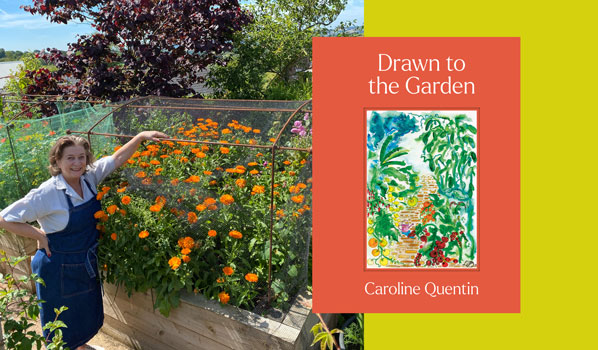
Caroline Quentin: Being an actor and a gardener is not a happy combination

Caroline Quentin Gardening McCarthy Holden

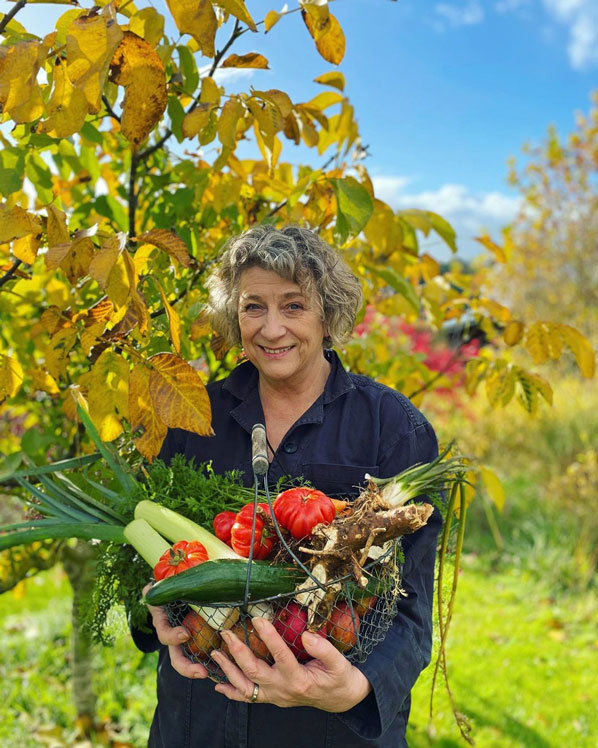
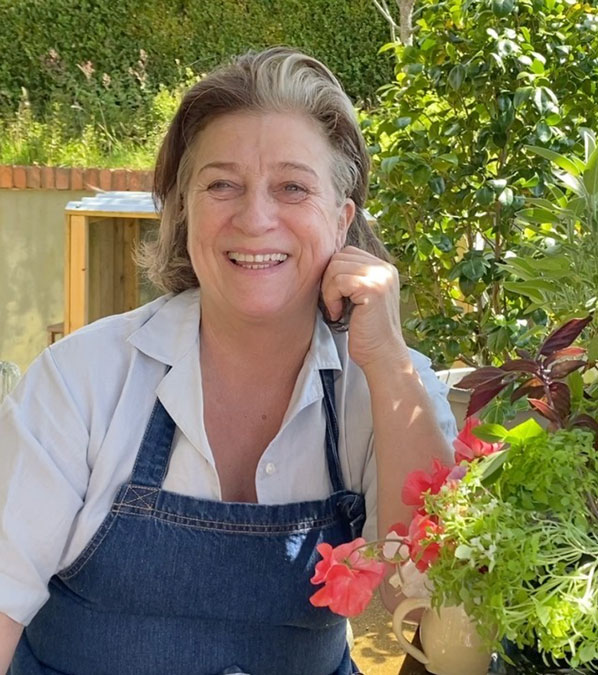
The Men Behaving Badly and Life Begins star, who recently appeared in Sky sci-fi series The Lazarus Project, also offers a wealth of advice and tips to her 150k followers on Instagram (@cqgardens).

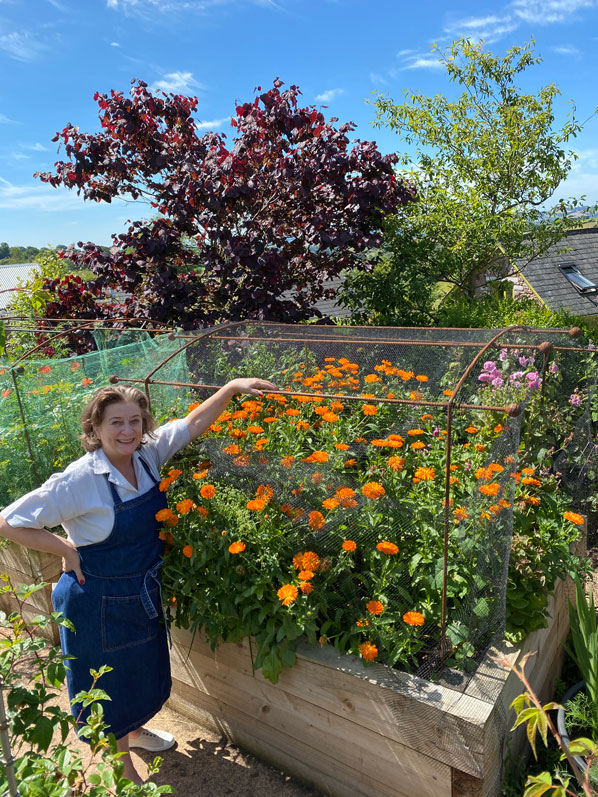
Her husband, Sam, does much of the filming when she invites followers into her home near Tiverton in Devon, where she makes all sorts of dishes from ingredients she has grown, and shows us what she’s up to in her two-acre garden – which features an orchard, pond, greenhouse, raised vegetable beds and a flower garden, where the magic takes place..

Caroline Quentin Gardening McCarthy Holden

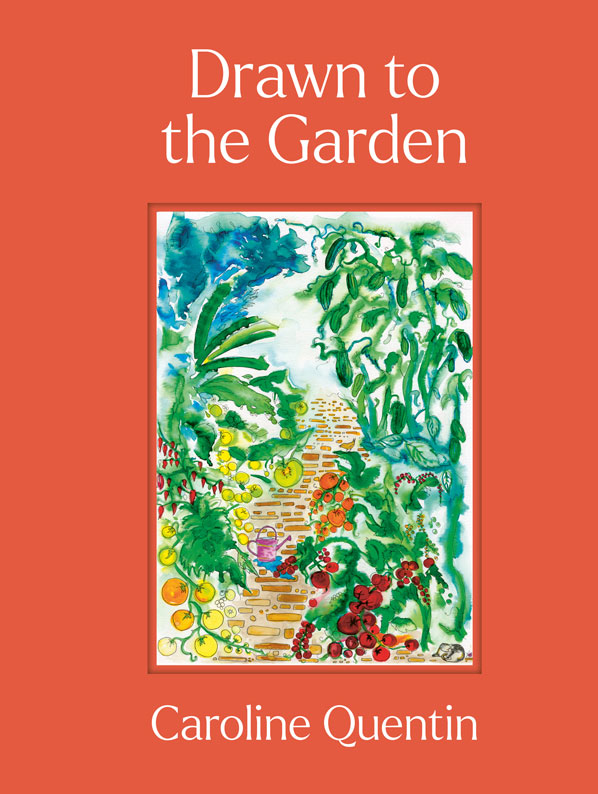
Now, Quentin has written – and illustrated – a new book, Drawn To The Garden. It’s part memoir, part guide, with chapters on seeds, salads, fruit and veg, water, herbs, pets and pests, memories and anecdotes meandering through each section.

Her garden, she says, is “not immaculate”. Weeds haven’t taken over, but she allows some buttercups and daisies to encourage bees.

“By my nature, I’m quite a chaotic person, so I don’t need things to be immaculate, but my vegetables are in a rotational system. I’ll mow a path through the grass rather than cut all the grass. I garden organically.”

The book also features a chapter on wellbeing, an important element to Quentin, whose mother suffered from bipolar disorder and spent periods in a psychiatric hospital, she recalls in the book.

When she was allowed to visit, she’d spend time in the hospital gardens, surrounded by marguerites, which she still loves.

“I genuinely believe that growing things, watching the birds, smelling the roses, eating the green stuff and drawing and painting, all help keep me this side of sanity and one step away from the big dark house on the hill,” she writes.

Here, she tells us more…

Caroline Quentin Gardening McCarthy Holden

How much has gardening benefited your mental health?

“I consider it responsible for my wellbeing. I am by nature someone who goes up and down. I have mood swings, I get low. And if I do feel low, the first thing I turn to is my garden, or if I can’t be near my garden, the nearest open space or natural environment.”

Did you always have access to a garden?

“As a little girl, we had a long strip of suburban terraced house lawn. It was not really a gardening space. Nobody in my house was particularly interested in gardening.

“I wouldn’t say I was a gardener when I was young but at primary school, I’d put a seed on a bit of blotting paper or a bulb in a jam jar with water underneath and it was fascinating. The whole optimism about growing things is always a good thing.”

What was your garden in Devon like when you first moved there?

“It was a derelict property, with just a field and a trickle of stream at the bottom. There was no garden. That was about 17 years ago.

“I put the pond in first because I knew when you put water into a garden, nature comes, and that was what I was most interested in. It was one of the most exciting things I’ve ever done with a garden. I swim in it too.”

How do you juggle your acting career with looking after the garden?

“You tend to film in the summer months, and gardening obviously happens a lot in the summer months as well. So I tend to be in the greenhouse in January, February and March, getting everything ready, sowing my seeds, getting the garden ready, and then suddenly the phone will ring and I’ll need to be away from the garden when everything needs to go in and be planted out. Being an actor and a gardener is not really a happy combination. The time balance is somehow wrong.

“I’m filming two dramas this year. I do get homesick. I’m really bad at being away from home, which is weird given that I do it for 90% of my life. But it’s a small price to pay for what has been a very enjoyable career.”

Do you have help?

“Sam will water for me, but he’s not a gardener. Anthony (her gardener) has helped me over the years. He comes in for a morning a week.”

Caroline Quentin Gardening McCarthy Holden

How do you maintain your wellbeing in the garden?

“I hug trees, I talk to trees, I spend as much time as I can in woodland. They call it forest bathing. It’s a deeply rooted human thing to want to be in the shade or dappled light of a tree on a summer’s day.

“I don’t formally meditate, but I do have a process where I try to breathe well when I’m outside if I’m feeling stressed or trying to learn some lines and they’re not going in, or there’s too much to do. I do a little bit of yoga every day. In the summer, I can do that outside and get my breathing organised to just slow my heart rate down and breathe in some good air.”

What’s next?

“I’m planning to downsize and start a new garden (in Devon). My children (Will and Rose) have left home and we have a big house and big plot of land. I’m getting older and maybe it’s time for me to start thinking about a garden for someone in their 60s. I want to make my next garden as well, I don’t want to inherit one. At the moment I’m fixated on having bees. So I’m thinking of an orchard with bees in it, and possibly some wildflowers.”

What will you take from your old garden to your new garden?

“Probably water. What’s brought me the most joy is watching swallows over the pond on a summer’s evening. I would definitely grow apples again and I would have maybe three or four raised beds, and a greenhouse or potting shed.”

Drawn To The Garden by Caroline Quentin is published by Frances Lincoln on February 15, priced £20.

Caroline Quentin Gardening McCarthy Holden

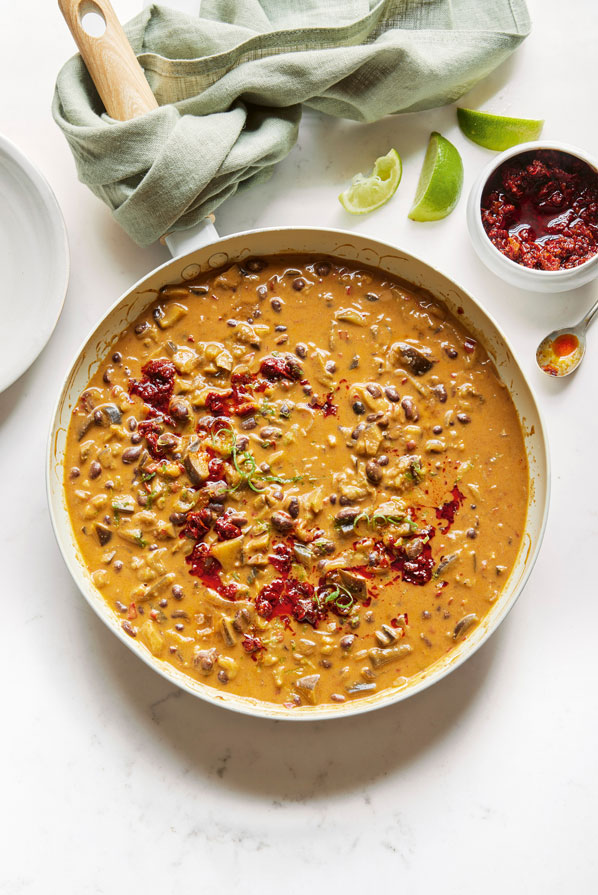
Ella Mills’ creamy black bean and harissa stew

Ella Mills Deliciously Ella McCarthy Holden news item

“The best thing about batch cooking is that the flavours of the dish tend to get better the longer they marinate, so the leftovers are always a real treat, and this is certainly the case in this recipe,” says Ella Mills, the brains behind Deliciously Ella.

“It’s hearty and cosy, with lovely spices from the harissa, sweetness from the coconut and maple syrup, and a delicious nutty flavour from the almonds. The aubergine gives it great texture, while the beans ensure it really fills you up. It’s great on its own for a light supper, or for something a bit more substantial serve it with jasmine rice, jacket potatoes or crispy roast cauliflower.”

Creamy black bean, harissa and almond butter stew

Ingredients:

(Serves 4)

1tbsp olive oil

2 shallots, halved and finely sliced

1 aubergine, finely diced into 1cm cubes

4 garlic cloves, crushed

1 × 400g tin of black beans, drained and rinsed

3tbsp harissa, plus extra to serve

1 × 400ml tin of coconut milk

400ml hot vegetable stock

2 heaped tbsp smooth almond butter

2tsp maple syrup

Grated zest and juice of 2 juicy limes

Sea salt and black pepper

Method:

1. Put the olive oil into a large frying pan over a medium heat, add the shallot and aubergine and a pinch of salt and fry for five minutes, until soft. Add the garlic, black beans and harissa and fry for two minutes, until fragrant.

2. Pour in the coconut milk, stock, almond butter and maple syrup. Bring to a boil, then put the lid on the pan and turn the heat down to a simmer. Cook for 15 minutes, until the sauce has thickened.

3. Stir in the lime zest and juice and season with salt and pepper to taste. Swirl an extra tablespoon of harissa through the stew to serve (if you’d like a little extra spice).

Note: To make crispy roast cauliflower, simply chop your cauliflower into small florets, place them on a baking tray with a tablespoon or so of olive oil and a sprinkling of salt and roast in an oven preheated to 200ºC fan for about 20–25 minutes, until golden and crispy.

My girls love this recipe too, so when I’m cooking it for the family I hold off on the harissa and stir it into the adult portions once I’ve served the little ones.

Ella Mills Deliciously Ella McCarthy Holden news item
Ella Mills’ creamy black bean and harissa stew

Deliciously Ella: Healthy Made Simple by Ella Mills is published by Yellow Kite, priced £22. Photography by Clare Winfield. Available now.

Ella Mills Deliciously Ella McCarthy Holden news item

These are the foods to eat to avoid colds and flu this winter

By Lauren Taylor, PA

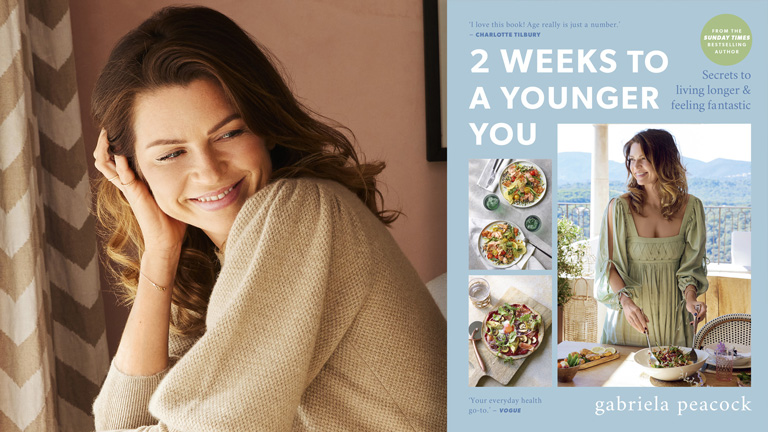
Nutritionist to the stars, Gabriela Peacock, has revealed the immune-boosting foods to get into your diet this winter, if you want to starve off dreaded colds and bugs.

A lot of people don’t realise just how interlinked winter health and nutrition are, says the 44-year-old, but our immune system “is directly dependant on what we put within the body to create a chemical reaction – it’s really, really important”.

Here are Peacock’s hero foods your body needs this winter…

Fermented food – “Digestion support is incredibly important for immunity – 70 to 80% of our immunity actually lies within a digestive system,” says Peacock, whose celebrity clients include Princess Beatrice, Joan Collins, Jodie Kidd and Amber Le Bon.

She recommends eating live yoghurts, kefir, kombucha, sauerkraut, kimchi and tofu. “They directly increase the beneficial bacteria in your intestine, which supports the healthy microbiome – and the healthy microbiome will in turn support our immunity.” They also contain protein. “Protein is really important for any kind of repair within the body, so when you have a cold, when you scratch your arm, when you need more hormones to be produced.”

How to add it: Peacock recommends using live yoghurt as a base for homemade ice cream with a dash of agave syrup.

“Sauerkraut goes really nicely with any kind of rich foods, which is what we tend to eat around this time, quite heavy and oily meals, sauerkraut cuts through it,” she says. “Kombucha is just a nice alternative when you get a bit bored of drinking water. Most of them are really, really low in sugar.”

Green tea – “This would be one of my one of my hero drinks, especially over this period of the year because tea is nice and warming. Green tea contains catechins which are polyphenols,” explains Peacock.

“Polyphenols are phytochemicals – plant chemicals that have numerous health benefits. One of the main benefits is immunomodulating properties [which] stimulate our immune system and decrease the chronic inflammation. Basically, when you’re looking at the immunity, you want to decrease the inflammation.”

How to add it: If you drink coffee, Peacock suggests sticking to one or two a day and then switching to green tea afterwards.

“A really good to tip is to put lemon in green tea – you increase the absorption of the catechins, plus it gets rid of the bitter taste. Don’t make the tea too hot because the heat will kill the vitamin C.”

Matcha tea – powdered green tea – is another great way to get the nutrients but is higher in caffeine. “I would recommend thinking about it as a caffeine supplement [to coffee],” she says.

Pigmented fruits – “We are looking for the dark pigments, [they] will contain the polyphenols which will directly stimulate the immunity. So think about black blackberries, red raspberries, red peppers, green kale, orange or yellow pumpkins – if and you see these saturated colours, they are really beneficial. “Eat the rainbow – beige food is not good for us. The pigment is the polyphenol.”

How to add it: “I would recommend doing smoothies because you are keeping the fibre inside [as opposed to juicing]. If you’re doing smoothies I always recommend adding some greens that are lying in your fridge. You will not taste it at all but you increase your colours, you increase your fibre,” Peacock says.

“I don’t dislike juicing but I would never have juice on an empty stomach. You should have it with foods or have it after foods. Think of it as more of a vitamin boost – as apposed to food.”  You can buy supplements of red and green superfood powder too, which she recommends adding to smoothies, live yoghurt or soup.

Omega-3-packed fish, nuts and seeds – “Essential fatty acids are incredibly important – the reason they’re called essential is because your body cannot produce them by itself, you need to obtain them by diet,” says Peacock. “Omega-9 and omega-6 we tend to be OK with [obtaining] but most people struggle with omega-3 because we just don’t eat enough of it. This would be oily fish; salmon, mackerel, sardines, a bit of tuna, also a vegetarian source; nuts and seeds.

“We need to at least three to four portions of oily fish per week in order to cover your basic baseline.”

Seeds, in particular, are really high in omega-3, says Peacock. “Pumpkin seeds, sunflower seeds, flax seeds, hemp seeds, also a nice variety of nuts is really important. Omega-3 is directly anti-inflammatory. They’re [also] really important for our skin, our hair, our hormonal balance, for the way our cells communicate with each other. But the prevention of chronic inflammation is one of the main benefits.”

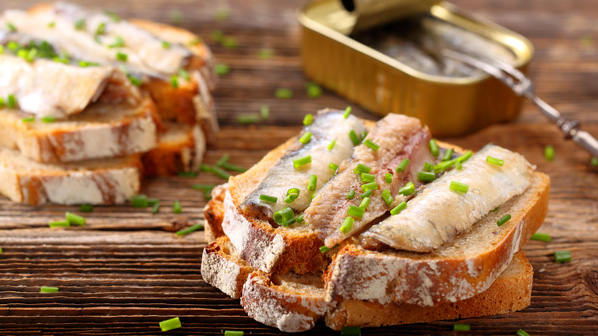
How to add it:  “You know what’s really good and really cheap – mackerel and sardines in a can. They’re kind of unattractive but I absolutely love them. You can get mackerel in a spicy tomato sauce [in a tin] – absolutely delicious.”

She suggests tinned sardines on toast, keeping bowls of seeds on your kitchen counter to add to everything (especially soups and porridge) and carrying nuts in your handbag. “Food source would be preferential but you can get supplements of omega-3 – 99% of my clients need supplementation.”

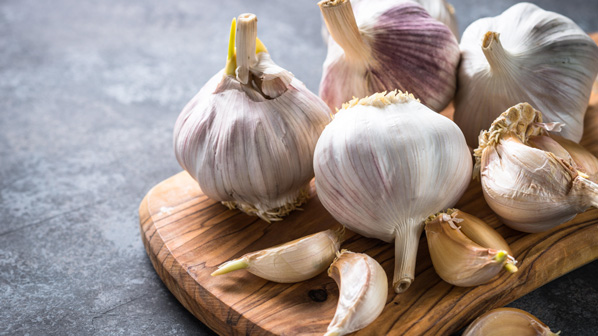
Garlic – Garlic contains sulphur (as do onions, leeks and eggs). “Sulphur is incredibly important because they stimulate the liver detoxification processes and that in turn will have a really positive effect on immunity.” Peacock says.

How to add it: “I would add it into everything really – include it as much as possible. With garlic, you only release the sulphur-containing compounds when you crush it, so it does need to be crushed down and not cooked for too long. Add garlic very last minute. The cooking process helps for the absorption but if you overcook it, if you deep-fry garlic, it will definitely reduce its properties.”

Cruciferous vegetables – Including broccoli, cauliflower, cabbage, Brussel sprouts and kale – are really important for immunity, Peacock says, and it’s “probably the best liver-supporting group of vegetables”. They contain liver-friendly sulphur, polyphenols and are high in fibre – which is “fantastic for digestion” (immunity and digestion are very much linked).

How to add it: Include different kinds in your Sunday roasts, she suggests. “If some clients of mine don’t like the taste or texture of cabbage or kale [I suggest] cutting them into really small pieces – you get exactly the same benefits and you don’t [notice] the texture.”

Citrus – Vitamin C is very important this time of year. “It’s a direct antioxidant, in order to fight free radicals, which is essentially what makes us sick. If you increase antioxidants in your diet, you’re increasing the protection, you’re giving your immune system protection,” Peacock says.”Grapefruit is high in vitamin C.”

How to add it: “If you want to increase your hydration (because not many people drink enough water), add a teeny bit of grapefruit juice to a lot of other water,” she suggests, “I use it for the kids’ water bottles. It’s important for it to be fresh [citrus] so you can get as much vitamin C as possible.”

These principles are incorporated in Gabriela Peacock’s latest book, 2 Weeks to a Younger You, (Kyle Books, £25). Supplements are available at GP nutrition.

Dame Mary Berry at 88: ‘I don’t want to retire at all – I love what I do’

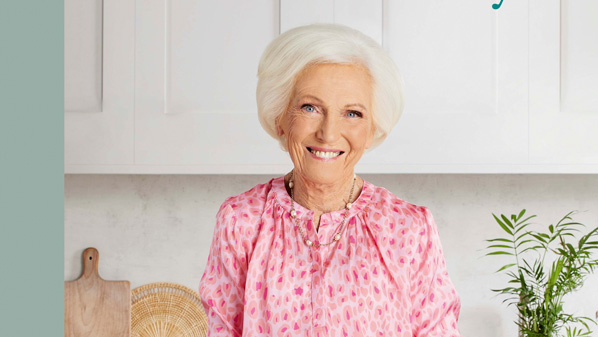
Mary Berry says she still has a “passion” for cookery and isn’t planning to hang up her apron any time soon.

“I don’t want to retire at all. I have a passion for what I do and I love teaching,” says the former Great British Bake Off judge, 88, who began her TV cooking career in the early 1970s.

“I mean, I’ve got wonderful health… I’m really lucky. I love what I do.” Born in Bath, she moved to London aged 21 and studied part-time at the prestigious Le Cordon Bleu culinary school, alongside jobs, doing cookery demonstrations and recipe testing.

“I’ve always worked very hard, early on taking any work that came my way,” says Berry, who married Paul Hunnings in 1966. The couple have two children, Annabel and Thomas (their other son William died aged 19). “I worked in a butcher, I worked in a fishmonger, I worked during the night when I was on a holiday in a bakery that made wonderful bread. My husband was with the two children while I worked.”

After becoming food editor at now-defunct Housewife Magazine, then Ideal Home (which is still going strong), Berry published her debut cookbook in 1970 and landed her first TV gig shortly after.

“My first TV cooking was with Judy Chalmers on Good Afternoon and I did farmhouse cooking,” Berry recalls.

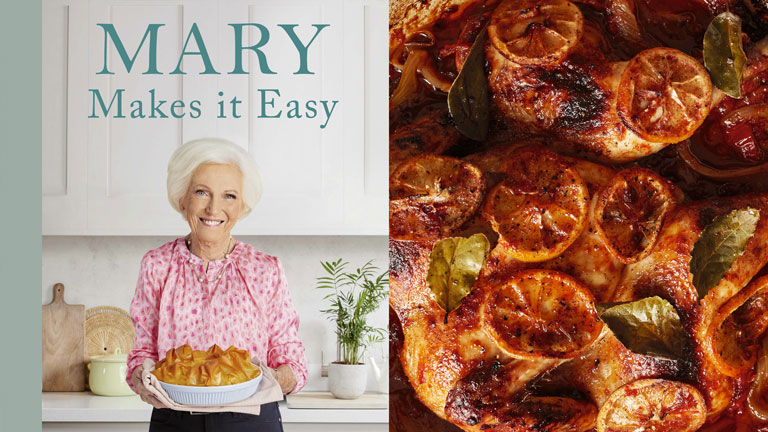
“I like to think that television is the best way of teaching to a very large audience. I want to inspire people to enjoy cooking more.” Quickly proving popular with viewers, she remained a fixture on TV screens over the next four decades, joining Paul Hollywood as a Bake Off judge from 2010 to 2016. “Of course you need the backup of a book,” Berry continues, nudging the conversation back to the topic at hand, her latest recipe book, Mary Makes it Easy.

“I like to feel that with a book I’m holding somebody’s hand who is a little bit nervous and trying a recipe the first time, and I want them to have real success.” Something in the region of her 96th cookbook (the exact total appears to be lost in the sands of time), it’s all about simplicity, with a focus on one-pot wonders (like chicken tartiflette or meatball toad in the hole), quick dinners you can prepare in advance (veggie bolognese; humble pie) and freezable sweets (elderflower and lemon traybake; maple and orange pudding).

“We all want something easy, don’t we?” says Berry, who admits even she still has the occasional slip-up in the kitchen.

“I forget to put the timer on, I take things out too soon, all the things a housewife – or whoever’s doing the cooking – [might do]. We all make mistakes.” Having experienced times when cash was tight, the frugal foodie has lots of advice for home cooks who want to cut costs. “It’s all about planning,” says Berry, who is a big fan of doubling up on recipes and freezing half for a later date.

“The freezer is like a second larder if you label things properly. I write, say, ‘roasted vegetable lasagna, very good’ and I may even put in my diary when I’m going to use it.”

As well as a culinary career spanning six decades, Berry – who became a Dame in the 2020 Birthday Honours – has been happily married for 67 years. What’s her secret to a harmonious home? “Well, you know in my day you got married for richer or for poorer, till death us do part, which to me is very important,” the octogenarian says.

“We don’t have arguments, I just go in the garden or the greenhouse if he’s annoying me. Try and never go to bed on an argument,” she advises. And count your blessings: “I’m immensely grateful still to have him. Many of my friends haven’t got their husbands.”

Recently, some of Berry’s 1970s TV demonstrations have found a new audience on TikTok, with quaint clips showing her making the trendiest dishes of the day, like chicken stroganoff, ox tongue (“such a lovely idea for a picnic”) and sherry trifle – not that she would know.

“I have no idea. I don’t do social things like TikTok, I don’t do Twitter,” says Berry (her assistant Lucy runs an Instagram account on behalf of the pair.) “It’s very nice that people are enjoying the early ones.” She gently admonishes me when I confess that I’ve never sampled tongue: “You can buy it ready sliced in the supermarket. Have you never had it? You’re a foodie…

“I like it very much, my husband does, too. We have it occasionally. It’s more reasonable than having ham.”

Having seen many a food fad come and go, the one she struggled to get on board with the most was nouvelle cuisine, aka “little bits of something on a plate”.

“All the chefs were doing it and I remember well my mother, I think it was her 100th birthday, and we went to a very posh restaurant, it was nouvelle cuisine,” Berry recalls.

“I can remember the plates arriving for my brothers and my cousins. My mother got hold of the waiter and said, ‘That’s not enough for a man!’ And she was quite right.”

Mary Makes it Easy is published by BBC Books, priced £28. Photography by Laura Edwards. Available now.are available 

Five minutes with… Hannah Waddingham for Home For Christmas

As Hannah Waddingham’s glitzy, musical show lights up homes and gets everyone in the mood for Christmas, we discover the behind-the-scenes fun.

If you were looking for something to get you in the Christmas spirit, look no further.

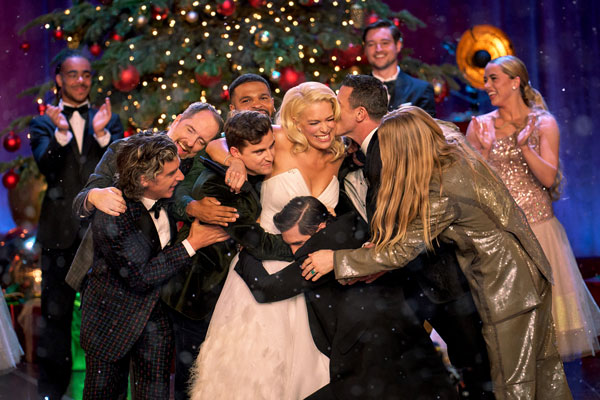
Hannah Waddingham’s Home For Christmas, an all-singing, all-dancing, high-octane special on Apple TV+ has all the festive ingredients you could ask for.

Sparkles, numerous dazzling outfit changes, an 18-piece band, glittering Christmas trees, wide smiles, nostalgic teary-eyed moments, comedic skits and countless festive musical numbers.

There are even cameos from Waddingham’s Ted Lasso co-stars.

Best known as a West End star in musicals including The Wizard Of Oz and for her Emmy-winning stint in Ted Lasso, Waddingham’s latest endeavour sees her front a dazzling Christmas special at the Coliseum theatre in London.

The location holds particular significance for Waddingham: many a childhood evening was spent in one of the boxes, bewitched as her mother, Melodie Kelly, a mezzo soprano in the English National Opera, performed on stage.

Joining Waddingham in this extravaganza are the likes of Hamilton’s Leslie Odom Jr, British singer Sam Ryder, Beauty And The Beast’s Luke Evans, the English National Opera, London Gay Men’s Chorus and The Fabulous Lounge Swingers.

We sat down with Waddingham, 49, to talk glitz, glam, outfits and performing alongside her special guests.

FIRSTLY, HOW WAS PERFORMING AT THIS FESTIVE SPECIAL? WHAT DID YOU LOVE ABOUT IT?

It was amazing. I was expecting it to be really exhausting but it just turned out to be completely thrilling, even though it was hours and hours long to film.

I hadn’t prepared myself for the moment when we weren’t on camera, having to sit back and talk to my director, Hamish Hamilton, in my ear and having to kind of hold the audience – that was actually the most tiring part of it, just trying to keep the energy in the room up. But I absolutely loved it.

THERE ARE SO MANY SPECIAL GUESTS, NOT LEAST YOUR TED LASSO CO-STARS. HOW WAS IT HAVING SO MANY LOVED ONES THERE WITH YOU?

Well, I found it a bit overwhelming really that so many of my Ted Lasso pals said ‘yes’. I thought maybe one or two would. But to literally have an embarrassment of riches from AFC Richmond was incredible and they tip it into something quite extraordinary.

TELL ME ABOUT YOUR DUETS. DID YOU HAVE A PARTICULAR FAVOURITE?

No, genuinely not – that’s why I chose who I chose. They all have their gifts. They all have their magic. And every single person brought it.

WHAT WAS THE REHEARSAL PROCESS FOR THOSE PERFORMANCES LIKE?

It was brief. Particularly people like Leslie Odom Jr, you know, he’s a busy man. He flew in, his flight was delayed. We literally sang the night he arrived. We went through it once and then we went through it again around the piano, and then the next day we did it. Just insane!

But musicians globally have a shorthand. So once it was myself and David Tench, my musical supervisor, and whomever of my guests, we literally went, ‘Right, shall we do it? Are you happy with that? What are we doing there? How do we get into that? What should we do there? Should we slightly change the harmony?’ And we feed off each other. It’s a real tribe.

WHAT WERE THE KEY ELEMENTS IN THE SHOW THAT MADE IT FEEL REALLY FESTIVE FOR YOU?

I think I wanted to create that kind of thing of everybody coming round to our house – like coming round for a Christmas party. I wanted people to feel like they could kick off their shoes, even if they were in the auditorium that night.

And even if you look at things like my duet with The Fabulous Lounge Swingers and Phil Dunster, we purposely put in that concept of Phil being in the auditorium and us being around the piano and that kind of ramshackle feeling, people thinking it was just discovered on route.

Even the cameos, the inserts that we put in there, I wanted people to be able to see everything – that kind of 360 of the whole venue, the backstage, on stage… all of it.

YOUR OUTFITS WERE INCREDIBLE! HOW DID YOU FIND WEARING THEM? DID YOU HAVE A FAVOURITE?

Well, we made them from scratch. They were very, very carefully created. Myself and James Yardley, my stylist, sat down together months and months ago and decided that we wanted to create as much of an emotional arc with the clothes as with the music.

So that first gold dress: I wanted it to be sparkly, I wanted it to be festive but not a punch in the eye in terms of being overtly Christmassy per se. And then I wanted it to be something that wouldn’t be distracting and would look very elegant and simple to go into that number that I dedicate to my mum and my daughter.

And then I wanted the second outfit to be more playful for my song with Sam Ryder: a bit more of a rock chick with a miniskirt but still the train to add the drama of theatre. And then of course, the last outfit, we needed something that was romantic and old school, like the time of Fred Astaire and Gene Kelly.

Autumn décor ideas for a seasonal refresh

AUTUMN INTERIOR

With a nip in the air and change in seasons comes a new dawn – and a natural desire to create a comfy, snug space ahead of the cooler months.

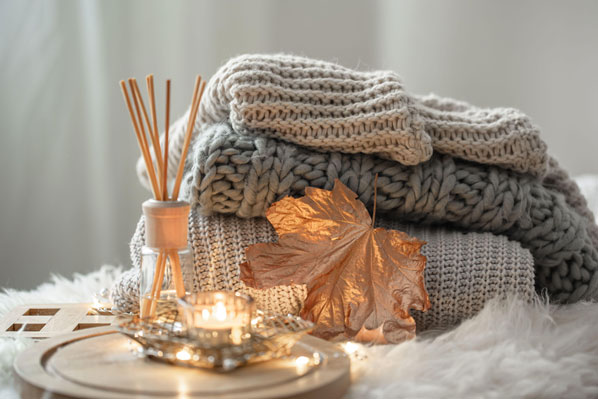
Alongside sumptuous textures, polishing up warm woods and ambient lighting, now’s also the time for seasonal candles.

Here, experts share their top tips for an autumnal aesthetic…

Forage for farmers’ market-style floral displays

“As we prepare for colder, darker months, it’s all about getting cosy and adding some extra touches that will make you feel cocooned and comforted,” says Charlotte Reddington, one half of styling and organising duo, Style Sisters. She says one of her favourite things things about autumn is the rich variety of textures and tones, from crunchy leaves to the abundance of changing colours in parks and gardens.

AUTUMN INTERIOR

“Be inspired inside your home and think about how you can weave these elements into rooms,” suggests Reddington.

“This can be through the addition of a statement autumnal floral display, including a rich array of crimson reds, dark greens and burnt orange.”

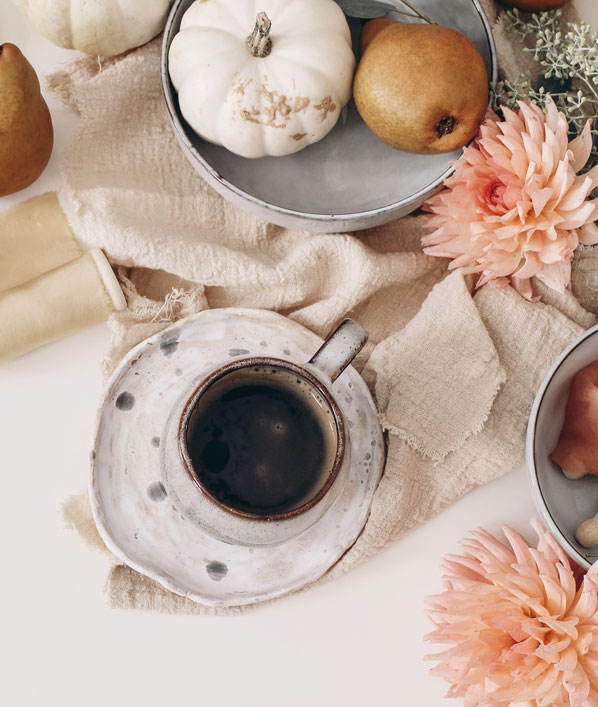
And with pumpkin season in full swing, don’t forget this colourful squash can be styled with foliage, berries and autumn wreaths.

Embrace cosier fabrics

“Shorter daylight hours mean only one thing – cups of guilt-free hot chocolate and plenty of movie marathons,” says Dani Burroughs, head of product for Snug.

“To get into the autumnal spirit, start by swapping out summer fabrics for cosier ones, like soft velvets or fuzzy boucle,” enthuses Burroughs.

“Bring in warm, inviting colours – think rich browns, deep reds and rustic oranges. Not only will they help transition from summer to autumn, they’ll also create a relaxing and warm feeling that’s perfect for those lazy evenings on the sofa.”

Introduce ambient lighting

Clever lighting can totally transform a room and the overall atmosphere, highlights Reddington.

“A harsh overhead light isn’t always the cosiest for an autumn evening at home on the sofa! Think about placing a large floor lamp or table lamps for some mood lighting, which will create a calming ambience.”

She continues: “And with darker evenings as the clocks go back, it’s an important factor to consider for maximum home comfort.”

Dec out your dining room to combine function with beauty

Look to Scandinavian-inspired styles for a mindful, minimalist and meaningful take on autumn decor, suggests Francesca Hadland, interiors expert for Bridgman.

“Choose linen tablecloths and napkins, cutlery in classic styles and simple crockery while keeping to a colour scheme of just one or two main shades that imbue your space with warmth,” says Hadland. “Whether that’s a rust red or forest green.”

Ahead of the festive season, she says to make sure your guests feel comfortable with upholstered dining chairs – a personal favourite.

“Whether modernised by a metal frame or softened by a wooden leg, an upholstered chair is a beautiful way to ensure a sublime seating experience, while also adding an extra pop of colour to your dining room décor scheme,” notes Hadland.

AUTUMN INTERIOR

Embrace the biophilic trend

“Bring some new life into your home ahead of the colder months by incorporating air-purifying houseplants into décor,” says Rikki Fothergill, bathroom expert at Big Bathroom Shop.

Especially in bathrooms and kitchens, which she says is hugely beneficial for improving the quality of indoor air, regulating humidity levels and reducing the risk of more serious problems, like damp or even mould.

“Look to include species like ivy and fern as these are known to be great for maintaining air quality”, suggests Fothergill. “Spider plants are perfect too, and make for a great addition to any bathroom touching on the biophilic trend.”

Scent the season

One of the very first things you notice (sometimes unknowingly) when you enter a room isn’t just how it looks, but how it smells, notes Reddington.

“Scent can evoke memories, elevate an atmosphere, and help to change your mood – from energising and lifting, to relaxing and even aiding sleep… we really think it’s one of the most important aspects of a home.”

Candles and diffusers are the most popular and easy addition, says Reddington. “Not only can they smell amazing, but the design can add a stylish decorative touch to a mantlepiece or coffee table.

“An absolute autumn home essential,” she adds.

AUTUMN INTERIOR

Five minutes with… Mary Berry for Mary Makes It Easy

MARY BERRY

By Rachael Davis, PA Entertainment Features Writer

For some of us, cooking can be a real chore. You might feel like you’ll never understand how to put together a nutritious, delicious dinner for your family, or you might think you simply don’t have time to get into the kitchen after a long day at work while juggling after school clubs, homework, and all the rest.

In her new programme for BBC Two, Mary Makes It Easy, former Bake Off judge Mary Berry gets together with celebrities with various levels of cooking experience to teach them exciting dishes that don’t take a lot of time, effort or skill.

MARY BERRY

She joins her famous friends Mel Giedroyc, Jordan North, Anton Du Beke, Lorraine Kelly, AJ Odudu, and Michael Ball to guide them, and us at home, through some scrumptious recipes that even those who’ve never made toast without burning it will be able to whip up in a flash.

Let’s hear more from Berry, 88, about what she gets up to in the kitchen.

WHY DID YOU WANT TO SHOW PEOPLE HOW EASY COOKING CAN BE IN THIS SERIES?

I’d listened to what people say, and they want easy recipes, things that don’t take too long, too many ingredients, and perhaps, from ingredients that they (have) got in their cupboard. So Makes It Easy was good for me to do, because I knew everybody would love it. Nice shortcuts as well.

WHAT DO YOU THINK PEOPLE FIND HARD ABOUT COOKING?

I think they find it difficult because time is short, and they’re cramming so much into their lives… It’s the decision making.

I say: don’t make it complicated, make it on the simple side and follow the recipe. First of all, follow it exactly as it is written, read it through two, three times, and then place yourself thinking how it’s going to work… Choose a recipe that your family are bound to enjoy, and that’s achievable in the time that you’ve got.

I love a one pot dish. I’ve got a recipe that has a couple of chickens that have been spatchcocked – that means the backbone’s taken out. You can buy them already prepared, if you like, and put everything in one dish, all the roasted vegetables around it. Absolutely delicious.

MARY BERRY

HOW WAS IT WORKING WITH THE CELEBRITIES IN THIS SERIES?

Well, all the people that I had wanted to learn to extend their repertoire, or to do something a little bit different.

Lorraine (Kelly) is not an experienced cook, at all. And she likes healthy food. I did a vegetarian mixed bean and red pepper chilli and thought it was lovely, and her daughter enjoyed it too.

Mel (Giedroyc), she’s already a good cook and just wanted a few more to add to her repertoire. She did a veggie ragu, which was all sorts of different vegetables, but all sorts of things that you’ve got to hand – who hasn’t got a bottle of red wine? And we’ve always got things like tomato, tinned tomatoes and tomato paste, and mushrooms. You know, not too unusual vegetables.

And some like cakes. Now, Jordan (North), not a very good cook, but was dying to make a cake.

His idea of a spread was something he called “picky tea”, and he just emptied all different bowls on the table and put the cubes of cheese in, peanuts, crisps – so this was stretching him!

I made, with him, a red velvet sandwich cake… It had a delicious texture which was given by buttermilk – that was a new thing for him, and a buttercream icing. And on the top, just bought truffles, the sort that I like, the white chocolate ones – that was delicious. He seemed to enjoy it.

I had Anton Du Beke, also. When I spoke to him, I said: “Well, what do you already cook?”.

He said: “I do eggs. I do boiled eggs, fried eggs, scrambled eggs, omelette”.

“Can you do anything else?”

“No!”

So it was perfect to show him how to do a chicken escalope with tzatziki. We always buy chicken breasts, don’t we? And to make them cook quickly, you just can beat them out, which is very, very simple.

You just put the chicken breast on a board and put some baking paper on top, and then bang it with a wooden rolling pin. And it will be double the size – well, not quite double, but a nice escalope.

We fry it with mustard, and parsley on top and chopped dill, and that goes into the pan with it. And it is delicious.

YOU MENTIONED MEL THERE. OF COURSE, PEOPLE LOVE SEEING THE TWO OF YOU TOGETHER, BUT THIS IS THE FIRST TIME YOU’VE COOKED TOGETHER, AND YOU GO CAMPING! HOW WAS THAT?

It was just as much fun as playing cards with her, we used to do that…

We think alike. We have great fun. And of course, she is very bright and took to camping. I mean, she does camp with her family in the Lake District, and so she was certainly guiding me with putting up tents and things, and I would tell her all about cooking.

WHAT’S YOUR BEST ADVICE FOR PEOPLE STRUGGLING WITH COMPLICATED MEALS, OR WITH TIME TO COOK?

Well, don’t choose complicated recipes! Choose simple recipes. And it’s very important that you take on board the sort of food that your family enjoys.

Check that you’ve got all the ingredients together, and perhaps choose something that you could cook double the amount of and put some in the freezer for next week. It’s nice to look in your diary and say: “I’ve made a note that I’ve already cooked that, and it’s beautifully cooked, in the freezer – all I’ve got to do is reheat it!”

Mary Makes It Easy starts on BBC Two at 7.30pm on Thursday, November 2.

Wildlife presenter Kate Humble on what really makes a house a home

KATE HUMBLE MCCARTHY HOLDEN NEWS ITEM

What makes a house a home? Is it the building itself, the possessions inside, the people that live there, the location or community?

It’s probably all of these to some degree, says Kate Humble, who delved into the topic for her new book, Where The Hearth Is – sparked by the TV presenter’s own quest to understand why a London Victorian terraced property she thought would be her ‘dream home’ never really felt like it, but the Welsh farmhouse she later moved to did.

“Before I moved to Wales, my husband and I had bought a derelict house in London. We spent 18 months sleeping on kind friends’ sofas, giving everything we earned to the builders to try and make it un-derelict and create what we thought was going to be our absolutely perfect house, with a lovely kitchen, all our bookshelves and pictures on the walls, and all the elements we believed would make it the perfect, happy home,” explains Humble, 54.

“And what was really odd and actually rather distressing was the day we moved in and unpacked, we thought that instantly it would be home. It wasn’t. And it never felt like home, and I couldn’t work out what we’d done wrong.”

She repainted walls, moved pictures, furniture and even walls in a bid to fix the issue: “I drove my husband completely mad. For the whole seven years we were there, I basically battled to try and make this house a home.”

She eventually realised the problem wasn’t so much the house, but the location. “The reason that poor house was never going to be home was that I wanted it to make me believe London was home, and it couldn’t do that.”

mccarthy holden news item Kate Humble book

Humble’s TV career has always focused on the countryside and nature, with shows like Springwatch and Countryfile, and for a long time she’d harboured a desire to live in rural Wales.

“I was never a city girl, I was brought up in the countryside,” she explains. “I had for quite a long time wanted to be back in the country, but because of my job, doing things like Springwatch, lots of wildlife programmes and programmes that took me out into the countryside, I could manage coming back to London. But it just ceased to feel like home.

“I had this weird, inexplicable – and I still haven’t worked out why this was the case – longing to live in Wales, even though I have no family history in Wales or heritage, and I hadn’t even really been on holiday there. I didn’t really have a connection. But for some inexplicable reason, I really, really wanted to live in Wales.”

Then, “completely out of the blue” in 2007, Humble’s TV producer husband Ludo was offered a job in Cardiff. “It was like fate was intervening.”

The couple bought an old stone farmhouse with four acres of land in the Wye Valley. “As soon as I got there, I knew I had found my home,” she recalls. “There are many elements of that, but I think it was instant because I was back in the countryside, and those were my roots, even though it wasn’t geographically where I’d grown up, I had grown up in a rural area – and I was back in a rural area and suddenly I felt like I belonged again.”

Yet although Humble, her husband and their dogs have lived happily in the farmhouse in Wales for the last 16 years, running the Humble by Nature working farm and rural skills centre nearby, they may still not be in their ‘forever home’ – which is what sparked the idea for the book.

“For a long time, I’ve wanted to build a house of my own,” she reveals. “I’ve got the design in my head – I’ve always been fascinated by the idea of creating the place that I end up living.

“But the thing that worries me is, I might build this house one day that I think is perfect – but what will it be that turns it from a building I’ve imagined in my head, a physical thing, into the nebulous but nonetheless essential thing that makes it a home? What will shift it from simply being a building with furniture and a bed, into the place where you feel safe and secure and at home? What do I need to do to make sure that I don’t repeat the experience I had in London?”

Humble was so worried about this, she wrote long lists of the sort of people that might be able to give her insight into what makes a house a home. “I started off by thinking that would help me build a thesis, a kind of Humble theory of what makes a home, if you like.”

She spoke to many people, compiling stories for the book – ranging from brother and sister Willie and Ruby Brown, both in their late 70s, whose home (a 150-year-old family stone croft on the west coast of Shetland, where they’d been born and raised) was struck by lightning and destroyed, to a Syrian woman who lost not just her home in the war, “but her community, her culture, her language, everything she knew”, explains Humble.

“She had to start from scratch, trying to make a home in a country that wasn’t hers, and the thing she said made the UK feel like home was the kindness of people.

“What I learned was home doesn’t stop or start when you walk into the front door – it’s more than that,” Humble adds. “And for a lot of people – and I would include myself in this – community is really important, what’s around you, what do you look out at through your window?

“Of course, there’d be things that all of us, if they were lost through fire, flood or whatever, we’d probably mourn. But ultimately, possessions are ephemeral – one day they’ll fade, fall apart, or get lost. Whereas the people in your life are the fabric of your home. When I walk around my house and think what would I grab if the house was on fire, I think, well I’d grab my husband and my dogs,” Humble reflects.

“What I discovered is what makes a home is incredibly personal and individual to each person. But if you have a place you can genuinely call home, where you feel safe and secure and it’s your refuge, actually, you’re very lucky.

“Through talking to all these people and putting this book together, I realised how precious home is.”

Where The Hearth Is: Stories Of Home by Kate Humble is published by Aster, priced £22. Available now.

mccarthy holden news item Kate Humble book
×
Find a Property
M
Country & Equestrian
By submitting this form, you agree to McCarthy Holden using your personal data in accordance with our Privacy Notice.